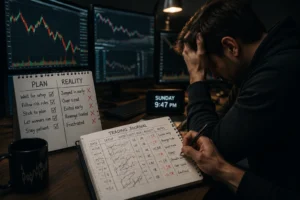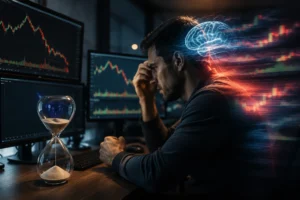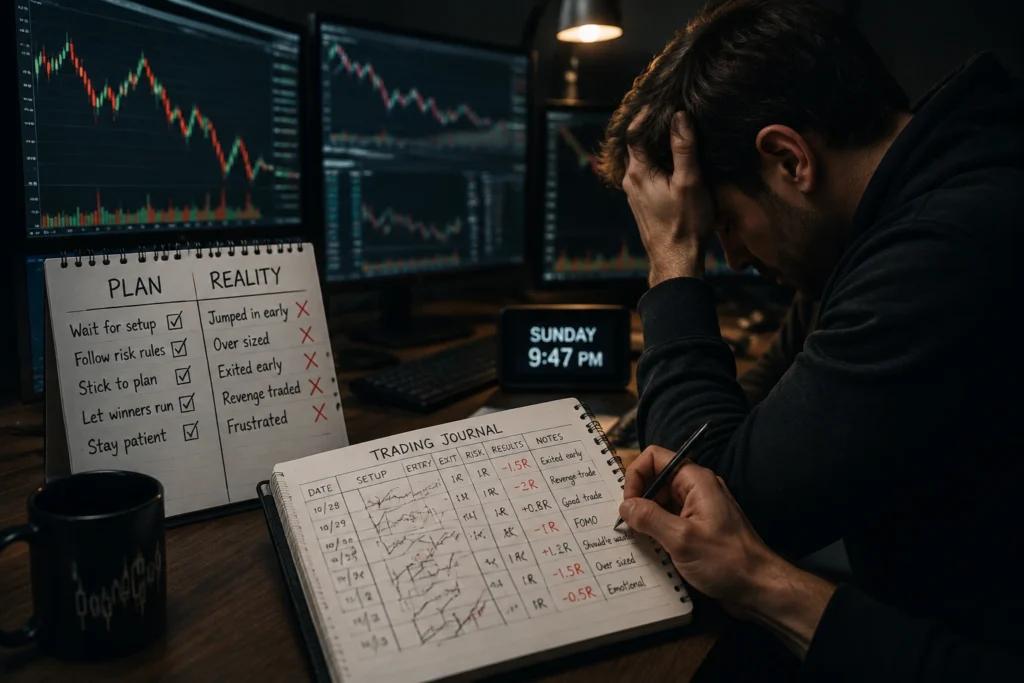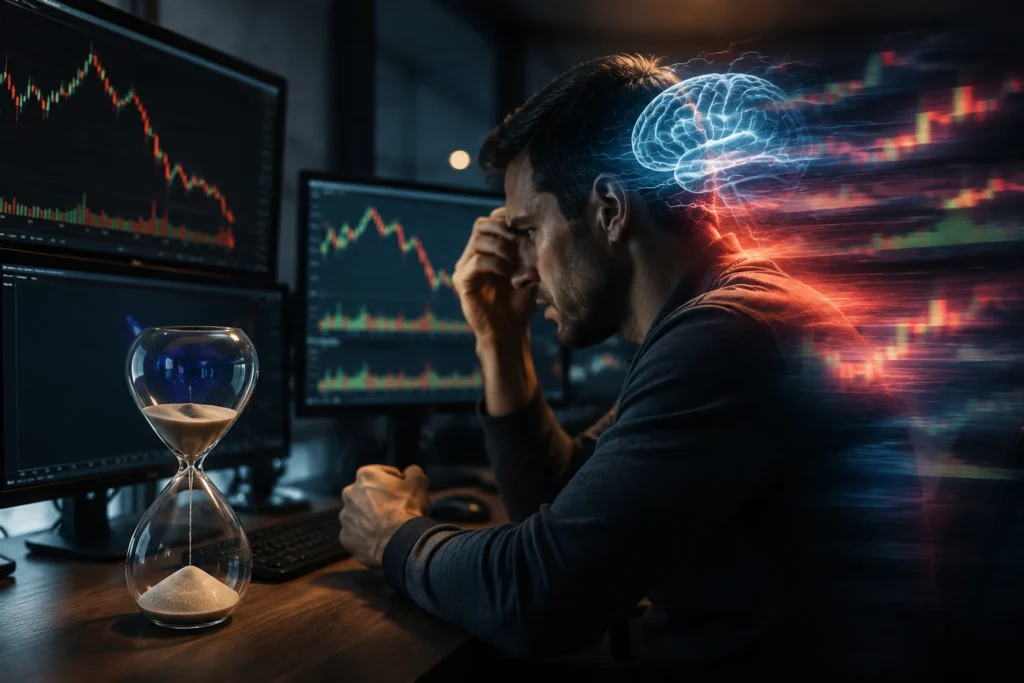

Sleep loss doesn’t just make traders tired. It specifically impairs the brain’s ability to learn from losing decisions, which means a sleep-deprived trader can repeat the same costly mistake within the same session without the usual internal alarm going off.
This is a different mechanism than fatigue or slower reaction time, and it’s the piece most sleep advice for traders leaves out entirely. Most guidance on this topic focuses on energy and focus. The more specific and more damaging effect happens at the level of how the brain processes negative feedback, and that has direct consequences for anyone managing risk under real conditions.
What Does Sleep Deprivation Actually Do to Trading Decisions
Sleep deprivation impairs risk-based decision-making by reducing activity in the prefrontal cortex, the brain region responsible for weighing consequences and learning from negative outcomes, while increasing activity in reward-driven circuits. A study using the Iowa Gambling Task tested participants at a rested baseline and again after 49.5 hours of sleep deprivation. At baseline, participants learned to avoid the high-risk options as the task progressed. After sleep loss, they showed the opposite pattern, choosing more frequently from the risky options as the task went on.
That reversal is the mechanism worth paying attention to. Rested decision-making improves over time because the brain updates based on negative feedback. Sleep-deprived decision-making gets worse over time because that updating process breaks down. In trading terms, this maps directly onto a familiar pattern. A rested trader who takes a bad trade adjusts. A sleep-deprived trader who takes a bad trade often takes a similar one again shortly after, because the internal signal that should have flagged the pattern isn’t firing with the same strength.
Why Do Sleep-Deprived Traders Take Bigger Risks Instead of Smaller Ones
Sleep-deprived individuals tend to take larger risks specifically because reduced prefrontal cortex activity weakens the brain’s capacity to inhibit impulsive, reward-seeking choices, while limbic and reward circuits remain relatively active. This produces overconfidence in uncertain situations rather than caution, which runs counter to the common assumption that tiredness should make people more careful.
Research on sleep deprivation and financial decision-making notes this directly, pointing out that financial market professionals frequently work through the night or on minimal rest, and that this can push decisions in two possible directions. If sleep loss distorts how uncertainty is perceived, a trader might become overly cautious and avoid legitimate opportunities. If sleep loss produces overconfidence instead, which the research indicates is the more commonly observed pattern, a trader becomes more willing to take on risk they would normally decline.
Trader Insight: This helps explain a pattern many traders notice without naming it correctly. A rough night of sleep followed by a session that feels unusually confident is not always a sign that conditions are genuinely favorable. It’s sometimes the reward-seeking system running with less oversight than usual.
How Does One Bad Night of Sleep Compare to Chronic Sleep Restriction
A single night of significant sleep loss and ongoing, chronic sleep restriction both impair decision-making, but they don’t necessarily produce identical effects, and chronic restriction is the more common condition among active traders. Most sleep and trading discussions focus on the dramatic case, staying up all night before a major session. The more relevant reality for most traders is a slow accumulation of five or six hours a night over weeks, which research on sleep-deprived risk-taking has linked to measurably increased activation in brain regions associated with risk modulation.
| Sleep Condition | Primary Effect on Decision-Making | Common Trading Behavior |
| One severely disrupted night | Sharp, temporary drop in negative-feedback learning | Repeating a recent mistake within the same session |
| Chronic partial restriction | Gradual erosion of impulse inhibition | Slow drift toward oversized or unplanned positions |
| Consistent adequate sleep | Full prefrontal engagement in risk evaluation | Faster correction after a losing trade |
The middle row is where most traders actually live, which is exactly why the effect often goes unnoticed. There’s no single dramatic night to point to. There’s just a gradual loosening of the internal checks that would otherwise catch a pattern before it compounds.
What Does This Mean for a Trader’s Actual Process
The practical takeaway isn’t a generic reminder to sleep more. It’s that sleep quality directly affects one of the specific mechanisms a disciplined trading process depends on, the ability to notice and correct after a loss before repeating it. A trader running on inadequate sleep isn’t simply slower. They’re operating with a weaker version of the exact feedback loop that separates a controlled drawdown from a compounding one.
This connects directly to the kind of post-loss review work covered in the M1 methodology, where the goal is building a reliable process for recognizing and correcting a losing pattern before it repeats. Sleep is one of the physiological conditions that determines whether that process has a fair chance of working on any given day.
Frequently Asked Questions
Does lack of sleep make traders more cautious or more reckless? Research indicates sleep deprivation more commonly produces overconfidence and increased risk-taking rather than caution, since reduced prefrontal cortex activity weakens the brain’s ability to inhibit impulsive choices while reward-seeking circuits remain active.
Can one bad night of sleep really affect a trading session? Yes, studies using decision-making tasks have found that even a single period of significant sleep deprivation impairs the brain’s ability to learn from negative outcomes, which can lead to repeating a losing decision pattern within the same session.
Is chronic sleep restriction worse than one severely disrupted night for traders? Both impair decision-making, but chronic partial sleep restriction is more common among active traders and tends to produce a gradual erosion of impulse control rather than one obvious lapse, which makes it harder to notice and correct.
What specific brain function does sleep loss affect during trading? Sleep loss specifically reduces activity in the prefrontal cortex, the region responsible for weighing consequences and updating decisions based on negative feedback, while leaving reward-driven brain circuits relatively more active.
The Feedback Loop That Actually Needs Protecting
Sleep for traders is about protecting the specific brain function that lets a losing trade actually teach you something before the next one gets placed.
Traders who notice repeated mistakes clustering after poor sleep are picking up on a real, measurable pattern, not a coincidence. The M1 Mental Trading Academy works on building the process discipline that holds up even when conditions like sleep aren’t ideal, since the goal is a system resilient enough to catch a mistake before it repeats.