
Two traders look at the exact same setup. Same chart, same news, same risk parameters.
One waits a beat, takes the trade cleanly, and walks away regardless of outcome. The other freezes for half a second too long, then forces an entry that has nothing to do with the original plan.
The market did not change between those two traders. What changed was how each one’s brain handled the compressed window of time the decision had to happen in, and that distinction is the entire subject of this article.
What Decision Making Under Pressure Actually Means
Decision making under pressure in trading refers to the cognitive and behavioral changes that occur when a trader must evaluate risk and act within a compressed time window, often while capital, reputation, or both are directly at stake. Pressure here is not just psychological. It changes the actual mechanics of how the brain weighs information.
A study published in PLOS One on risky financial decisions under time pressure found that decision quality shifts measurably when time constraints are introduced, with participants relying more heavily on simplified heuristics rather than fully processing available information. The researchers specifically noted that the time pressure used in their study was likely weaker than what professional traders experience in live markets, meaning the real-world effect is plausibly stronger than what the lab demonstrated.
The Speed and Accuracy Trade-Off Nobody Mentions
Most articles on trading psychology skip past a basic finding from decision science. Speed and accuracy are not independent. When one goes up, the other tends to go down, and trading puts professionals directly inside that trade-off every single session.
A 2023 paper on accuracy-time trade-offs in decision making confirmed that compressed timeframes lead to perceptual narrowing, meaning reduced vigilance and reduced working memory capacity in the moment a decision needs to be made. This is not a willpower failure. It is how attention physically allocates itself when the brain perceives urgency.
That same paper highlights a finding worth sitting with from personality research, noting that individuals high in neuroticism and, somewhat counterintuitively, those high in agreeableness showed performance that “choked under pressure,” dropping significantly under time or social pressure compared to no-pressure conditions. Pressure does not affect everyone identically, and pretending it does is part of why generic advice on this topic so often misses the mark.
TRADER CHECKPOINT
Before reading further, think about your last genuinely pressured decision. Not a routine trade, the one where the clock felt like it was working against you.
Did you actually evaluate the setup, or did you default to whatever felt fastest? Most traders cannot honestly tell the difference in the moment. That is exactly the gap this article is addressing.
What Happens in the Brain When the Clock Starts Running
Neuroscience research gives a more precise picture of what changes under pressure than psychology alone can offer.
A study on response urgency and decision making under risk identified the striatum and insular cortex as key regions involved when urgency is introduced into a risky choice. The research found that urgency influenced both decision times and heart rate responses, and that this effect interacted directly with the expected value of each choice on offer. These regions are heavily involved in value representation and the programming of action, meaning urgency does not just make a trader feel rushed. It changes which parts of the brain are doing the deciding.
Separate fMRI research on prosocial and self-concerned decision making under time pressure found that low time pressure situations involve greater activity in the prefrontal and parietal cortex, the hippocampus, and the striatum, the regions associated with deliberate, considered evaluation. Under high time pressure, the brain shifts toward a faster, less deliberate mode that discards more of the available information.
This lines up with something I have said for years without needing the neuroscience to back it up, though it is genuinely satisfying to see it confirmed. Reactive decisions and responsive decisions are not the same process running at different speeds. They are different processes entirely, and pressure determines which one your brain defaults to.
Why Risk Tolerance Itself Shifts Under Pressure
Here is something that surprises a lot of traders. Time pressure does not just make decisions sloppier. It actually changes how much risk a person is willing to take, and not in one consistent direction.
A study on decision making under time pressure using sequential sampling models found that under time pressure, participants became more conservative at lower risk levels but more prone to take risks at higher levels of risk, a crossover pattern that reflected a reduction in decision threshold rather than a switch in overall strategy. In other words, pressure does not just turn traders more reckless or more cautious uniformly. It distorts the relationship between risk level and willingness to act in ways that are difficult to predict without understanding the mechanism.
This is part of why “just be more careful” is such weak advice for trading under pressure. The instruction assumes risk tolerance is stable and simply needs dialing up or down, when the research shows it actually reshapes depending on the specific risk level involved.
The Behaviors This Produces on a Real Desk
Generic content lists fear and greed. Here is what pressure actually produces in live trading conditions.
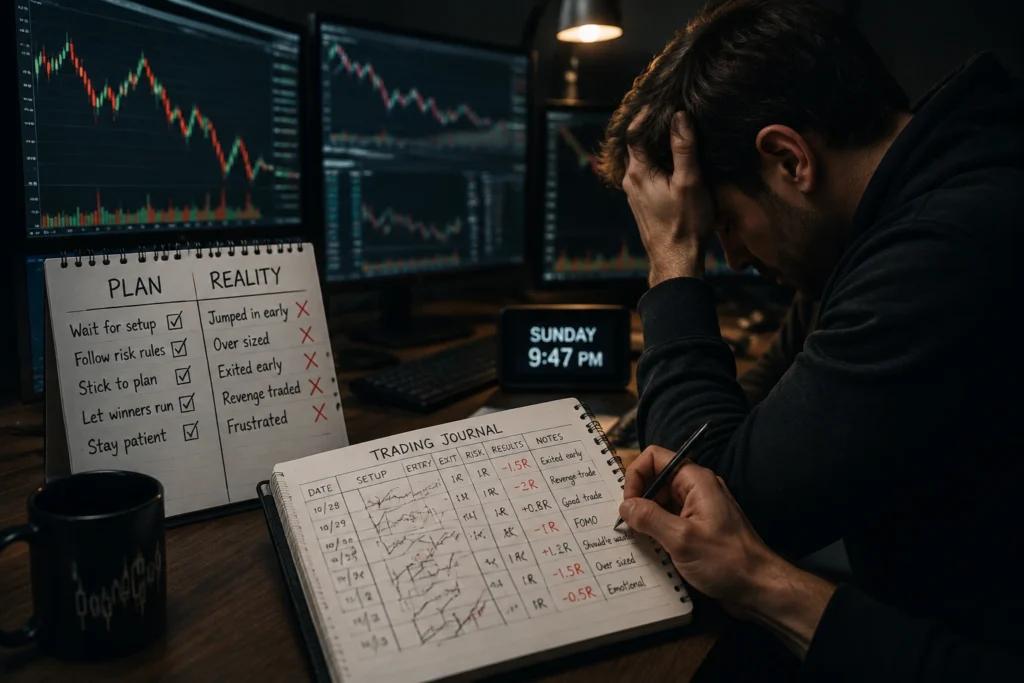
Premature exits on winning positions happen because the brain, operating in its faster and less deliberate mode under pressure, locks onto the immediate gain rather than weighing the full distribution of outcomes the original plan accounted for.
Oversized entries on marginal setups occur when urgency pushes a trader past the threshold where a setup would normally get passed on, especially at higher perceived risk levels where the sequenti al sampling research shows pressure increases risk appetite rather than reducing it.
Frozen hesitation on genuinely strong setups happens at lower risk levels, where the same research shows pressure makes people more conservative, sometimes to the point of missing a clean opportunity entirely.
Compressed analysis under a ticking clock leads traders to grab the first piece of confirming information rather than weighing competing signals, a direct consequence of the reduced working memory capacity documented under time pressure conditions.
A Different Way to Build Capacity for This
This is a performance sport, and pressure performance is trainable the same way physical conditioning is.
The most direct lever is widening mental space, the gap between what happens and what you do next. Under pressure, that gap collapses toward zero by default. Deliberately rebuilding it, even by a second or two, is enough to shift a decision from the brain’s faster heuristic mode back toward something closer to deliberate evaluation.
I worked with a portfolio manager who consistently made his worst decisions in the final minutes before a major data release, exactly the kind of compressed, high-stakes window this research describes. We built a specific pre-release protocol that gave him a forced pause before any action, training the nervous system to treat that window differently than the rest of the session. The setups did not change. His relationship with the clock did.
| Decision Style Under Pressure | What the Brain Is Doing |
| Fast, low-deliberation choice | Heuristic-driven, narrowed attention, reduced working memory use |
| Slow, considered choice | Greater prefrontal and hippocampal engagement, fuller information use |
| Frozen hesitation | Conservative shift at lower perceived risk, decision threshold rising |
| Forced oversized entry | Risk-seeking shift at higher perceived risk, threshold dropping |
FAQs
Does time pressure always make trading decisions worse? Not uniformly. Research using sequential sampling models shows time pressure can make traders more conservative at lower risk levels and more risk-seeking at higher risk levels, rather than simply degrading every decision in the same direction.
What part of the brain is most affected by decision pressure? Research on response urgency points to the striatum and insular cortex as key regions involved in risky decisions made under urgency, alongside reduced engagement of the prefrontal cortex and hippocampus that typically support more deliberate evaluation.
Can decision making under pressure actually be trained? Yes. Building deliberate mental space, even small amounts, has been shown to shift decisions back toward more considered evaluation rather than the faster heuristic mode the brain defaults to under urgency.
Why do some traders perform better under pressure than others? Personality traits play a measurable role. Research summarized in a 2023 review found that traders high in neuroticism or high in agreeableness show larger performance drops under time and social pressure compared to those lower in these traits.
Is pressure performance the same as emotional regulation? They overlap but are not identical. Emotional regulation addresses the physiological stress response itself, while decision making under pressure specifically addresses how compressed time windows change the cognitive process behind a choice.
Where to Take This Next
The clock is not actually your enemy in trading. The untrained gap between the clock and your decision is.
The M1 Mental Trading Academy builds the specific capacity to widen that gap under real pressure conditions, not in theory. For the complete framework behind this work, the M1 methodology breaks down exactly how it gets built.
The next time the clock starts working against you, will you actually notice which mode your brain has switched into?