
The session that should have gone perfectly is sometimes the one that starts the damage.
A trade closes exactly as planned. The size was right, entry was clean, exit was clean. The account is up. Every part of your brain is telling you this was skill, this was the process working, and the next trade deserves at least the same conviction.
That feeling is the problem.
A single good result changes how the brain evaluates risk immediately afterward in ways that have nothing to do with what the next setup actually offers. The shift is quiet, it feels like confidence, and it almost always shows up in the trade that follows before the trader notices it happened.
The House Money Effect and Why It Applies to Every Winning Trade
The house money effect is a well-documented behavioral finance concept describing how people treat profits differently from original capital, and it is one of the clearest mechanisms behind why a winning trade can quietly damage the sessions that follow.
Research published through the National Institutes of Health on prior wins and risk-taking confirmed that participants became risk-prone after experiencing a win, with profits being mentally treated as “house money” that could be risked more freely than original funds. The feeling of insulation created by a gain is real, but the risk attached to the next trade is not reduced by the previous result in any objective way.
Gains feel detached from real consequences. They register psychologically as winnings rather than capital, and that registration changes what size, what setup quality, and what exit behavior feels acceptable in the very next decision.
What Self-Attribution Bias Does to the Trade After a Win
The house money effect explains the changed risk appetite. Self-attribution bias explains why the trader feels so certain about it.
After a winning trade, the brain attributes the outcome to skill. The entry was sharp, the read was right, the process worked. That attribution is not always wrong, but it almost always overstates how much of the result was skill versus favorable market conditions that happened to align with the position.
Self-attribution bias in trading leads to overestimating abilities during winning periods and underestimating external factors, which produces overconfidence and excessive risk-taking in the trades that follow. A manager whose fund outperforms for a period gets treated as though they possess genuine alpha when the performance may not be statistically distinguishable from variance. The same logic applies to a single trader who closes two or three good trades in a row.
The specific behaviors that follow are predictable. Position size increases slightly without a deliberate decision to increase it. Entry criteria loosen because the filter that was holding back marginal setups suddenly feels like it was being overly conservative. New instruments or strategies that were not part of the tested plan start to look interesting.
FIELD NOTE
One of the clearest patterns I have seen across traders at every level is the account that peaks on a Tuesday and gives most of it back by Thursday because the winning Tuesday changed how those traders approached the next three sessions, and none of them tracked the shift while it was happening.
Why Dopamine Makes This Hard to Catch in Real Time
A winning trade produces a dopamine release, and that dopamine reinforces the behavior that preceded it in ways that are not calibrated to how good the setup actually was.
The brain does not distinguish between a high-quality setup executed well and a lower-quality setup that happened to work. Both produce the same neurochemical reward. That reward inflates confidence in whatever the trader did before the win, which is exactly why the trade immediately after a win often looks structurally different from the original plan even though the trader believes they are following the same process.
This is the specific gap that most traders never close. They review losing trades in detail. Winning trades get celebrated and the session notes for them tend to be thin, since there seems to be nothing to examine when the outcome was positive. The behavioral shift that happened during and after that winning trade goes untracked.
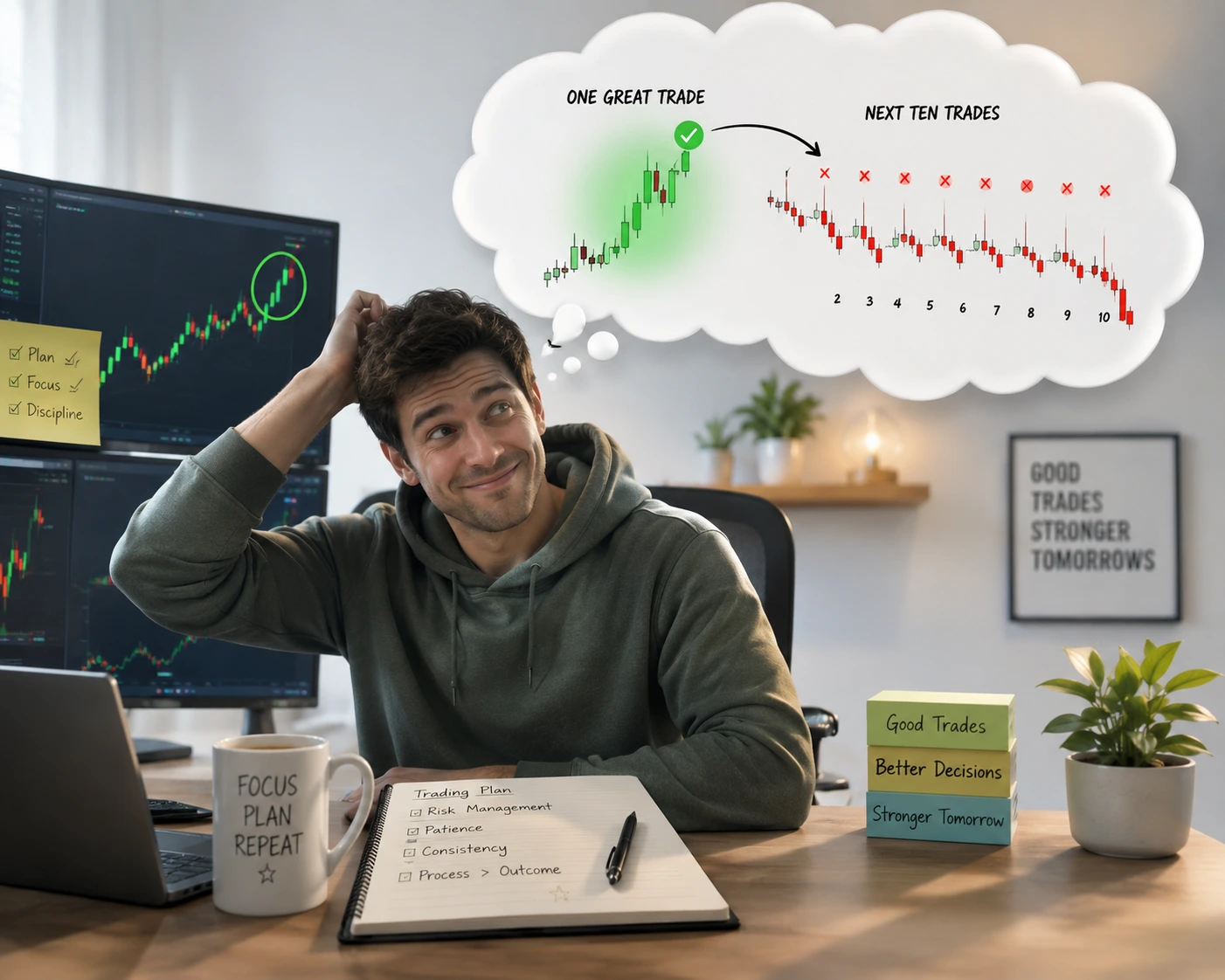
What the Next Ten Trades Actually Look Like After a Good One
The pattern is consistent enough across different trading styles and instruments that it is worth naming specifically.
The trade immediately after a win tends to carry slightly more size than the plan allows. The entry is taken a few ticks earlier or on thinner confirmation than normal because the elevated confidence reads as a legitimate assessment of the setup rather than as a residue of the previous result.
If that second trade also works, the confidence compounds. If it does not work, the loss tends to feel small relative to the previous gain because of the house money framing, which can lead to holding the position longer than the rules support rather than cutting it cleanly.
By the fifth or sixth trade after a strong win, the original plan is often running in a significantly altered form, with wider entries, different sizing, and looser criteria. The trader usually does not notice this as a drift from the process. It registers as a natural evolution of confidence that the recent results seem to justify.
A Simple Check That Catches This Early
The most practical intervention is building a specific review step into the session notes for every winning trade, not just for losing ones.
Before the next trade after a win, answer three questions honestly.
First, is the position size on the next trade exactly what the plan specified, or has it changed from what it would have been yesterday? Second, does the setup meet the same entry criteria that were required before this win, or have those criteria shifted in a way that would have previously disqualified the trade? Third, is the conviction behind this next entry coming from the setup itself, or from the result of the previous trade?
None of those questions require a long session review. They take about ninety seconds and they create the specific pause that the dopamine-driven confidence surge would otherwise eliminate.
FAQs
Why do traders often lose money right after a winning trade? A winning trade activates the house money effect, which causes profits to feel psychologically separate from real capital and more acceptable to risk, and triggers self-attribution bias, which inflates confidence in the trader’s current read on the market. Both shifts produce worse decision-making in the trades that follow.
What is the house money effect in trading? The house money effect is a behavioral finance concept where traders treat recent profits as less real than original capital, leading to increased risk-taking with gains. Research confirms participants become risk-prone after experiencing a win, with the prior gain creating a feeling of insulation that does not correspond to any actual reduction in risk.
How does dopamine affect trading decisions after a win? Dopamine released after a winning trade reinforces the behavior that preceded it without distinguishing between high-quality and low-quality setups. This makes traders feel their current judgment is sharper than usual, even when the confidence is a neurochemical response to the win rather than a genuine read on the next opportunity.
What is self-attribution bias in trading? Self-attribution bias is the tendency to attribute wins to skill and losses to external factors. After a winning trade, it causes traders to overestimate how much of the result was skill versus variance, which inflates confidence and risk appetite in subsequent decisions.
How can a trader catch this pattern before it damages multiple sessions? Running a brief three-question check before the next trade after a win, covering position size, entry criteria, and the source of conviction, creates enough of a pause to identify when confidence is tracking the previous result rather than the current setup.
Where to Take This Next
The session you celebrate is sometimes the one worth watching most closely.
Building the structured review habits and behavioral tracking that catch this pattern early is exactly what the M1 Mental Trading Academy is designed around. For the complete framework behind this approach, the M1 methodology explains how the training gets built from the ground up.