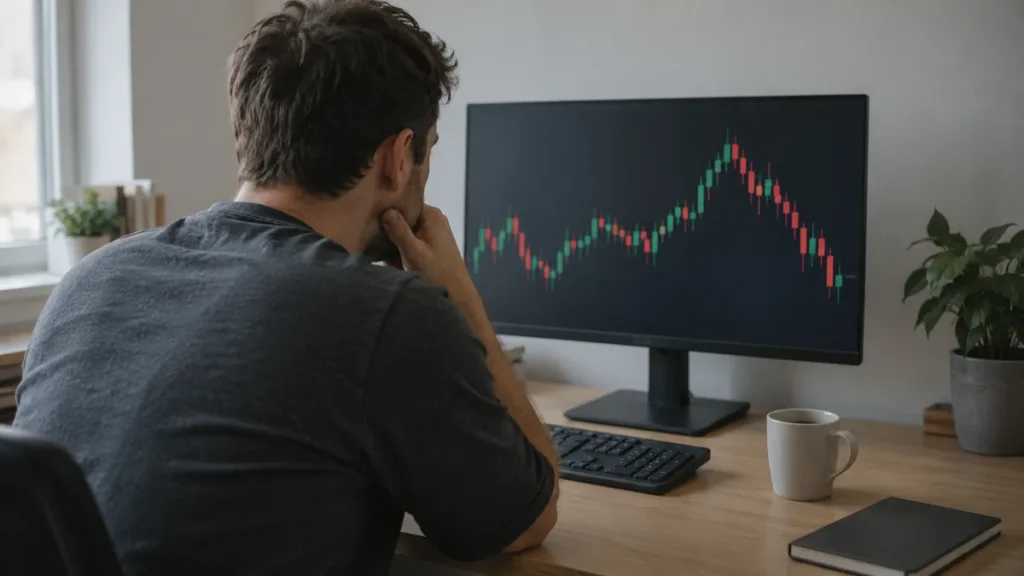


Most traders blame the market when an afternoon session goes wrong. After 25 years of managing institutional capital, I’ve learned that’s rarely the real reason. It usually starts before you even touch the charts. A tough conversation with a senior partner, a risk review that leaves a bit of tension, or a small comment that sticks in your head longer than it should. You don’t feel it as something big, but it follows you back to your desk.
Then you start trading and things slowly slip. A position runs longer than your rules allow, size creeps up without a clear decision, and you take a trade that doesn’t really fit your normal flow. Nothing feels obviously wrong at the moment, but it doesn’t look like your usual execution either.
What’s happening is stress carrying over into decision-making. That earlier pressure shifts your internal state, and your judgment around risk and timing gets a bit distorted without you noticing. Most traders never catch that shift while it’s happening, so they only see the impact after the session is already over.
What Is Actually Happening in Your Brain After Stress
Your brain does not return to baseline the moment a difficult conversation ends.
Research on post-stress decision-making shows that the cortisol response peaks approximately 20 to 40 minutes after stress onset. This means the chemical peak often arrives after you have already sat back down, reopened your positions, and started making decisions that feel completely normal from the inside.
What Cortisol Does to the Prefrontal Cortex
The prefrontal cortex handles working memory, the ability to hold multiple variables in mind simultaneously, and risk evaluation that extends beyond the immediate moment.
Amy Arnsten’s research at Yale demonstrated that sustained stress exposure weakens the synaptic connections within this exact architecture. Cortisol can impair attentional control and behavioral flexibility, two capacities that are foundational to executing a sound process when capital is moving.
When those functions degrade under stress, your decisions do not feel impaired from the inside. That invisibility is precisely what makes it so expensive.
The Time Distortion Effect
Under normal conditions, a trader can hold the entry thesis, current price action, risk parameters, and time horizon in mind at once. When cortisol peaks, that cognitive window narrows significantly.
Research published in Communications Psychology found that higher cortisol levels led to lower decision quality and a significantly higher incidence of experienced time pressure, even when no external deadline existed.
For a trader, this shows up as urgency that has no identifiable market source. Decisions that warrant five deliberate minutes start feeling like they need to happen immediately. That pressure is coming from inside the nervous system, not from the screen in front of you.
Why the Afternoon Pays for the Morning
A difficult morning meeting may have its strongest decision-making impact during the first trading decisions of the afternoon rather than during the meeting itself.
Most traders would never trade immediately after physical exhaustion without acknowledging the impairment. Neurochemical impairment from a stressful event deserves the same honesty, and it rarely gets it.
When Difficult Sessions Stack on Top of Each Other
A single elevated-cortisol session is manageable if you catch it and adjust.
Repeated difficult sessions can keep the stress-response system activated and reduce recovery between sessions, which may leave a trader starting the next day from a less regulated baseline. According to the Mayo Clinic, chronic stress can disrupt multiple body systems, affect sleep, memory, and focus, and compound over time in ways that are not always visible until the effects are already present.
This explains why the third and fourth sessions of a difficult week can produce worse decisions than the first. The analytical capability remains fully intact. What has been worn down is the capacity to translate sound analysis into reliable execution under pressure.
I covered this pattern in depth during my conversation on AlphaMind Podcast Episode 135, specifically how traders going through a rough stretch are often starting each new session from a compromised baseline they cannot feel from the inside.
For a full breakdown of how stress accumulates across multi-day drawdowns, the M1 blog on drawdown neuroscience covers the progression in detail.
What Actually Helps
The standard advice around stress management is not wrong for general health purposes.
For the specific problem of cortisol impairing a live trading session, it does not work at the speed the situation requires.
Check Your State Before You Check the Charts
Before opening the platform after any stressful event, spend two minutes on a genuine internal assessment. Ask honestly whether your current physiological state matches the state you were in when you built your process.
If a difficult conversation has elevated your cortisol in the last hour or two, that is directly relevant information for how you size and sequence what follows. Adjusting your position sizing and decision parameters to reflect your actual cognitive state rather than your best-day capacity is accurate self-management, and the traders I have worked with who do it consistently are the ones whose worst sessions cause the least structural damage.
The Physiological Reset
Focused breathing can help shift attention and regulate emotional arousal. Research on attention-to-breath practices has shown reduced amygdala activation and increased amygdala–prefrontal integration, though the exact timing and effect size vary by person and context.
The 90-second Neuro Reset Protocol inside the M1 Mental Trading Academy is built for the specific moment between a stressful event and a high-stakes decision. It is a precision cognitive tool, not a general relaxation practice, and the distinction matters for how and when you deploy it.
Separating Event Impact From Market Reality
After a difficult morning, the emotional residue of that event tends to color how you interpret market information in ways you cannot fully detect in real time. A trade that looks like confirmation of your thesis may be getting read that way partly because you need it to be true.
Developing the capacity to separate these two inputs is something I address in detail through the M1 methodology framework. Building this separation as a reliable capability requires structured repetition rather than willpower applied in the moment.
After a rough meeting, the afternoon session was always going to be more dangerous than it looked.
Building a system that catches that danger before it runs is where serious traders create a measurable edge over their own worst tendencies.
FAQs
Can a morning meeting actually affect afternoon trading?
Yes, a stressful meeting can affect later trading decisions. Acute stress can elevate cortisol and increase perceived time pressure, which may reduce decision quality in demanding tasks.
What does cortisol do to trading decisions?
Elevated cortisol narrows your cognitive field, distorts your perception of time urgency, and reduces the prefrontal cortex’s capacity for working memory and deliberate risk evaluation.
Why do traders make worse decisions late in a difficult week?
Repeated difficult sessions can keep the stress-response system activated and reduce recovery between sessions, which may leave a trader starting each subsequent day from a less regulated baseline.
How long does cortisol stay elevated after a stressful event? The acute response peaks around 20 to 40 minutes after the stressor and can remain elevated for two to four hours depending on intensity.
What is one practical thing to do after a stressful meeting? A two-minute state check before opening the platform, followed by position sizing adjusted to reflect your actual cognitive capacity rather than your best-day parameters.