
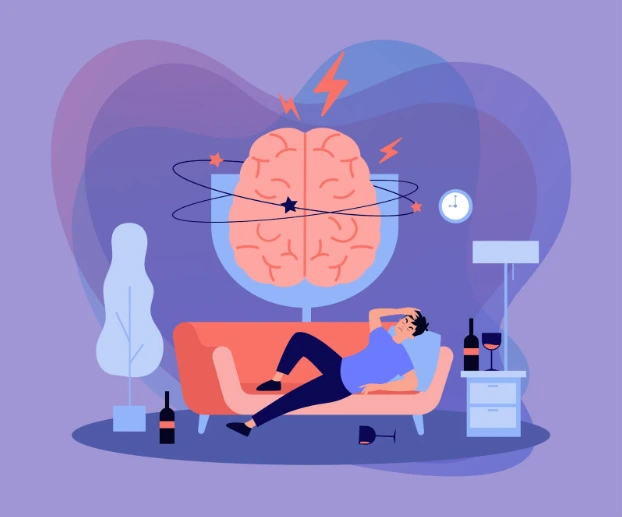

Mental fatigue is a psychobiological state caused by prolonged periods of demanding cognitive activity, characterized by a subjective sense of tiredness and a measurable decline in goal-directed attention and executive function.
Mental fatigue is not ordinary tiredness; it does not resolve with passive rest alone. For traders, executives, and athletes, mental fatigue is a direct brake on decision quality, emotional regulation, and sustained output. This page explains what mental fatigue is, how it develops neurologically, and what evidence-based strategies reverse it.
Defining Mental Fatigue: Beyond Feeling Tired
The Authoritative Definition
Mental fatigue is a psychobiological state arising from sustained, cognitively demanding activity. Kunasegaran et al. (2023), published via the National Institutes of Health, define mental fatigue as a condition characterized by reduced goal-directed attention, impaired executive function, and a subjective feeling of tiredness disproportionate to physical exertion.
Three components define the condition: a subjective feeling of depletion, measurable cognitive performance decline, and an underlying neural mechanism, specifically, reduced metabolic activity in the prefrontal cortex and altered neurotransmitter dynamics. (Boksem & Tops, 2008 — NIH/PMC)
Mental Fatigue vs. Physical Fatigue vs. Emotional Exhaustion
Mental fatigue, physical fatigue, and emotional exhaustion share surface-level overlap but differ in primary mechanism, affected system, and recovery requirement.
Marcora et al. (2009) established that mental fatigue originates in the central nervous system, while physical fatigue originates peripherally in muscular and cardiovascular systems, a mechanistic distinction with direct implications for recovery design.
| Feature | Mental Fatigue | Physical Fatigue | Emotional Exhaustion |
| Primary mechanism | Central (CNS) | Peripheral (muscles, cardiovascular) | Psychological (chronic stress response) |
| Primary sensation | Brain fog, apathy, cognitive slowness | Muscle soreness, weakness, breathlessness | Detachment, cynicism, depleted empathy |
| Brain region affected | Prefrontal cortex | Motor cortex, cerebellum | Limbic system, amygdala |
| Recovery method | Sleep, mental disengagement, micro-breaks | Rest, nutrition, light activity | Boundary-setting, emotional processing, therapy |
| Key measurable indicator | EEG theta/alpha waves, reduced HRV | Lactate threshold, muscle glycogen depletion | Maslach Burnout Inventory score |
Mental Fatigue vs. Emotional Exhaustion vs. Burnout
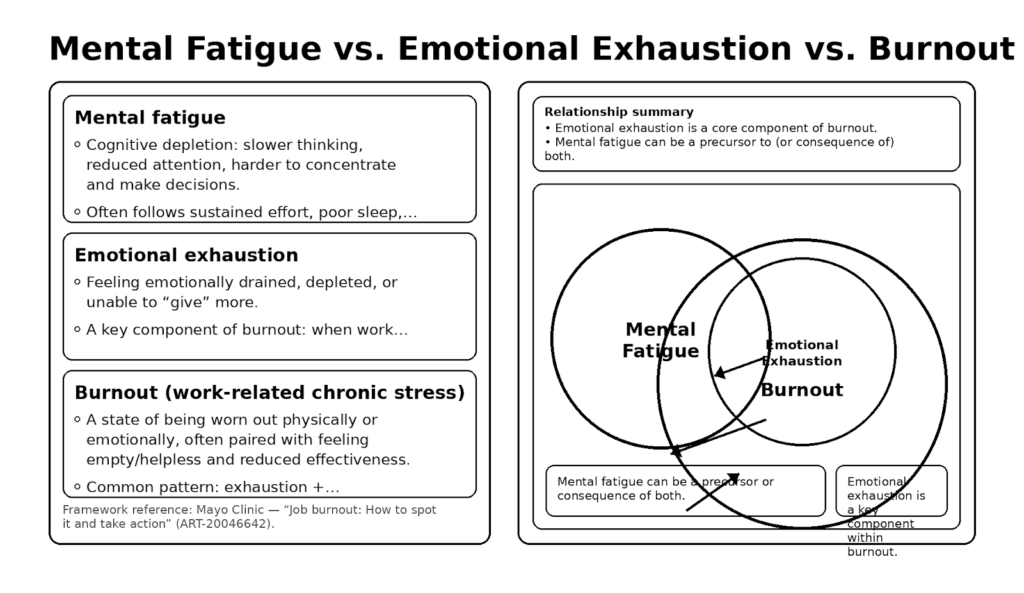
Emotional exhaustion is a core component of burnout syndrome, not a synonym for mental fatigue. The Mayo Clinic identifies emotional exhaustion as 1 of 3 dimensions of burnout, alongside depersonalization and reduced personal accomplishment. Mental fatigue precedes burnout when chronic cognitive overload remains unaddressed; it co-occurs with burnout when occupational demands sustain both simultaneously.
Signs and Symptoms of Mental Fatigue
Mental fatigue produces measurable deficits across 4 domains: cognitive, emotional, physical, and behavioral.
| Domain | Key Symptoms |
| Cognitive | Reduced attention span, impaired decision-making, brain fog, forgetfulness, slowed reaction time |
| Emotional | Irritability, apathy, emotional sensitivity, reduced motivation, feeling overwhelmed |
| Physical | Persistent tiredness unrelieved by sleep, headaches, muscle tension, appetite changes, and disrupted sleep |
| Behavioral | Procrastination, withdrawal from responsibilities, increased error rate, reduced work performance, and social withdrawal |
Cognitive symptoms, reduced attention span, and impaired decision-making are the primary markers distinguishing mental fatigue from general tiredness. The American Psychological Association identifies concentration difficulty and irritability among the most consistently reported effects of sustained psychological stress.
Physical symptoms that persist despite adequate sleep, particularly disrupted sleep and headaches, indicate the underlying cognitive stressor has not been addressed. (Mayo Clinic — Chronic Stress)
The Neuroscience: What Happens in the Fatigued Brain?
The Adenosine and Dopamine Mechanisms
Adenosine, a neuromodulator that accumulates with sustained wakefulness and cognitive effort, progressively inhibits arousal circuits in the prefrontal cortex, the region governing attention, planning, and inhibitory control.
As adenosine concentrations rise, prefrontal cortex metabolic activity decreases, directly impairing executive function. Caffeine reduces this effect temporarily by blocking adenosine receptors, but does not clear the underlying accumulation. (Porkka-Heiskanen et al., 1997 — NIH/PubMed)
Dopamine depletion constitutes a parallel pathway. Under sustained mental effort, dopamine levels decrease, reducing motivation, reward-driven task engagement, and the capacity for goal-directed behavior.
EEG studies confirm both mechanisms: Boksem & Tops (2008) recorded increased theta and alpha wave activity in the prefrontal cortex during mental fatigue states, measurable neural signatures of reduced arousal and cognitive slowing produced by both adenosine accumulation and dopaminergic decline.
Autonomic Nervous System Imbalance and HRV
Chronic mental fatigue shifts autonomic balance toward sympathetic dominance, measurably reducing heart rate variability (HRV), a physiological marker used to quantify cognitive recovery status. Tanaka et al. (2011) demonstrated that sustained mental fatigue produces parasympathetic withdrawal, reflected in HRV reduction across multiple frequency bands.
This autonomic shift contributes to allostatic load, the cumulative physiological cost of chronic stress, and elevates cortisol levels, compounding cognitive resource depletion over time.
Causes and Contributing Factors
Mental fatigue arises from 3 overlapping source categories: occupational demands, lifestyle patterns, and environmental or psychological stressors.
Occupational causes include high-demand knowledge work, decision fatigue from continuous high-stakes choices, constant context-switching between tasks, and long unbroken work periods without structured recovery. The APA identifies multitasking and frequent task-switching as significant contributors to cognitive load accumulation.
Lifestyle factors include chronic sleep deprivation, poor nutritional habits, physical inactivity, and information overload from continuous social media and news consumption. The CDC reports that 1 in 3 US adults do not obtain sufficient sleep, a scale of sleep debt with direct implications for mental fatigue prevalence.
Environmental and psychological stressors include chronic stress activating the hypothalamic-pituitary-adrenal (HPA) axis, sustained emotional labor, caregiving responsibilities, and financial strain. Prolonged HPA axis activation elevates cortisol, depleting the neural resources required for sustained executive function. (NIH/NLM — Stress Physiology, NBK541120)
Consequences for High-Performance Professionals
For traders, executives, and athletes, mental fatigue produces immediate, measurable performance consequences, more severe in financial and operational impact than in the general population.
Impaired Decision-Making and Elevated Risk Behavior
Mental fatigue degrades risk assessment accuracy, increases reliance on cognitive heuristics, and elevates error frequency. Hagger et al. (2016) documented that cognitive resource depletion increases dependence on automatic, heuristic-based processing over deliberate analytical reasoning. Harrison & Horne (2000) further established that fatigue impairs innovative thinking and increases perseveration errors, repeating ineffective strategies despite negative feedback, across decision tasks.
Reduced Leadership and Executive Capacity
Mentally fatigued leaders demonstrate reduced emotional regulation, impaired strategic foresight, and deteriorating communication quality, deficits that compound across teams and organizations.
The APA identifies emotional dysregulation and reduced cognitive flexibility as direct consequences of sustained psychological stress, both of which degrade leadership effectiveness at scale. Diestel & Schmidt (2012) further established that self-control demands in leadership roles accelerate cognitive resource depletion, directly reducing decision quality and team-level performance outcomes.
Recovery and Restoration: Evidence-Based Strategies
Immediate Interventions
Structured micro-breaks of 5–10 minutes every 90 minutes restore attentional capacity and reduce cumulative cognitive load. Ariga & Lleras (2011) demonstrated that brief, task-unrelated mental breaks prevent the sustained attention decline that occurs during prolonged focus on a single task.
4 evidence-supported immediate interventions:
- Micro-breaks (5–10 minutes every 90 minutes): disengagement from the primary cognitive task to prevent attentional resource depletion
- Power naps (under 20 minutes): restore alertness without producing sleep inertia or disrupting nocturnal sleep architecture
- Nature exposure (10–15 minutes): reduces cortisol and restores directed attention capacity via involuntary attention engagement
- Brief mindfulness practice (5–10 minutes): reduces autonomic arousal and supports parasympathetic recovery
Sleep, Exercise, and Nutritional Support
Sleep enables glymphatic clearance, the brain’s metabolic waste-removal process, and restores neurotransmitter balance depleted by sustained cognitive effort. The NIH National Institute of Neurological Disorders and Stroke confirms the glymphatic system is primarily active during sleep, clearing metabolic byproducts, including those associated with cognitive dysfunction.
Moderate aerobic exercise increases Brain-Derived Neurotrophic Factor (BDNF), a protein that supports neuronal repair, synaptic plasticity, and cognitive recovery. Cotman & Berchtold (2002) established exercise as a behavioral intervention that directly enhances brain plasticity and mood regulation.
Nutritional support for mental fatigue recovery centers on 3 priorities: consistent hydration, stable blood sugar through complex carbohydrates and adequate protein, and omega-3 fatty acid intake. The NIH Office of Dietary Supplements identifies omega-3 fatty acids as essential to neuronal membrane integrity, with documented roles in supporting cognitive function and reducing neuroinflammation.
Cognitive Disengagement
Cognitive disengagement, engaging in activities that require low cognitive load, activates the brain’s default mode network, the neural system responsible for memory consolidation, self-referential processing, and creative integration.
(Raichle et al., 2001 — PNAS) Default mode network activation is the neurological basis for why genuine rest, not passive screen time, constitutes recovery.
When to Seek Professional Support
Distinguishing Fatigue from Clinical Conditions
Mental fatigue that persists beyond 2 weeks despite lifestyle modifications, or that includes persistent sadness, loss of interest, or significant functional impairment, warrants clinical evaluation. The Mayo Clinic identifies symptom duration exceeding 2 weeks and marked functional decline as the clinical threshold distinguishing major depressive disorder from situational fatigue.
5 conditions require professional differential diagnosis, not self-identification:
- Depression: distinguished by persistent low mood, anhedonia, and functional impairment lasting 2 or more weeks, regardless of external stressor removal
- Anxiety Disorders: distinguished by excessive, uncontrollable worry disproportionate to the situation, often accompanied by physical symptoms including rapid heart rate and muscle tension
- ADHD: distinguished by chronic, developmental-onset inattention and impulsivity present across multiple life domains, not triggered by a specific cognitive stressor
- Chronic Fatigue Syndrome (ME/CFS): distinguished by post-exertional malaise, symptom worsening following minimal physical or cognitive effort, lasting 6 or more months
- Sleep Disorders: distinguished by clinically confirmed disruptions to sleep architecture (polysomnography), including sleep apnea, insomnia disorder, or circadian rhythm disorders
The Role of a Mental Performance Coach
A mental performance coach addresses cognitive load management, recovery system design, and sustained executive function, distinct from clinical therapy and specifically structured for high-performers. The APA defines coaching psychology as a discipline focused on enhancing well-being and performance in non-clinical populations, applying evidence-based behavioral and psychological methods.
Where a therapist addresses psychological disorders, a performance coach builds the operational systems, structured recovery, attention management protocols, and cognitive load regulation that prevent mental fatigue from becoming a chronic performance ceiling.
FAQs
Is mental fatigue a real medical condition?
Mental fatigue is a recognized psychobiological state documented extensively in peer-reviewed neuroscience literature. Kunasegaran et al. (2023), published via NIH/PMC, define it as a state caused by prolonged cognitive activity producing measurable declines in attention and executive function. Mental fatigue is not a formal diagnostic category in the DSM-5 but is a clinically validated phenomenon with measurable neural correlates, including EEG theta/alpha wave changes and HRV reduction.
What is the difference between mental and physical fatigue?
Mental fatigue originates in the central nervous system; physical fatigue originates in peripheral muscles and the cardiovascular system. Mental fatigue produces brain fog, apathy, and impaired decision-making. Physical fatigue produces muscle soreness, weakness, and breathlessness. Recovery for mental fatigue requires sleep and cognitive disengagement; physical fatigue recovery requires rest, nutrition, and light activity. (Marcora et al., 2009)
What are the signs of mental fatigue?
The primary signs of mental fatigue span 4 domains: cognitive, emotional, physical, and behavioral. Cognitive signs include reduced attention span, impaired decision-making, and brain fog. Emotional signs include irritability, apathy, and reduced motivation. Physical signs include persistent tiredness unrelieved by sleep and disrupted sleep patterns. Behavioral signs include increased error rate, procrastination, and social withdrawal.
How do you recover from mental fatigue?
Recovery from mental fatigue requires both immediate interventions and foundational lifestyle adjustments. Immediate interventions include structured micro-breaks of 5–10 minutes every 90 minutes and power naps under 20 minutes. Foundational recovery requires consistent sleep to enable glymphatic clearance, moderate aerobic exercise to increase BDNF, and genuine cognitive disengagement from work demands. Persistent symptoms beyond 2 weeks warrant professional evaluation.
Conclusion: Mental Fatigue as a Manageable Variable
Mental fatigue is a biological constraint on cognitive performance, not a personal limitation or a sign of weakness. The neuroscience is unambiguous: sustained cognitive demand depletes adenosine clearance capacity, reduces dopamine availability, decreases prefrontal cortex activity, and shifts autonomic balance in ways that directly impair decision-making, emotional regulation, and executive output. These are measurable, reversible processes.
With structured recovery protocols, evidence-based interventions, and a clear understanding of the mechanisms involved, mental fatigue moves from an invisible performance ceiling to a managed variable. Managing mental fatigue as a measured, reversible variable is the performance edge.