

Overconfidence bias is the tendency for investors to overestimate their knowledge, skills, and ability to control market outcomes, making it one of the most costly cognitive errors inbehavioral finance. Overconfidence bias belongs to a broader family ofbehavioral finance biases that distort investor decision-making across every market cycle.
Kahneman (2011), Thinking, Fast and Slow, identified overconfidence as one of the most robust and replicated findings in behavioral science.Barber & Odean (2000), The Journal of Finance, confirmed its financial cost empirically, documenting that overconfident investors trade more frequently and earn lower risk-adjusted returns as a direct result.
Overconfidence bias manifests through three core mechanisms:
- the illusion of control,
- the better-than-average effect, and
- miscalibration.
Left unchecked, these mechanisms produce four measurable portfolio costs:
- overtrading,
- under-diversification,
- return-chasing, and
- systematic underperformance.
Overconfidence bias is not a rare personality trait, but a default feature of human cognition. It activates most reliably in environments that reward pattern recognition, exactly the environment that financial markets create.
Why Do Investors Become Overconfident?
Overconfidence bias persists because two interlocking psychological mechanisms continuously rebuild it. The first mechanism is the illusion of control: a deep-seated need to impose certainty on markets that are inherently probabilistic. The second mechanism is self-attribution bias: a systematic distortion in how investors interpret the outcome of every trade.
Overconfidence as a Cognitive Bias
Overconfidence bias is a well-documented cognitive bias within behavioral finance. It is rooted in the psychological need to impose certainty on environments that resist it.Langer (1975), Journal of Personality and Social Psychology, demonstrated that people assign higher confidence to chance outcomes the moment they have any procedural involvement in the process. Markets trigger the illusion of control constantly. Every trade an investor places creates a sense of agency. That sense of agency inflates perceived control over largely random outcomes.
The Self-Attribution Link
Self-attribution bias amplifies overconfidence by reinforcing the wrong lesson from every trade. Wins are credited to skill. Losses are assigned to external factors, such as bad luck, market manipulation, or events outside anyone’s control.
Daniel, Hirshleifer & Subrahmanyam (1998), The Journal of Finance, modeled this dynamic directly: investors who attribute gains to personal ability become measurably more overconfident after successful trades. This self-attribution produces identifiable momentum patterns in securities markets, such as sustained price rises after earnings beats, followed by predictable reversals. Each winning trade makes the next overconfident decision feel more justified.
What Are the Three Core Mechanisms of Overconfidence Bias?
Overconfidence bias operates through three distinct mechanisms: the illusion of control, the better-than-average effect, and miscalibration. Each mechanism is independent. In practice, all three reinforce one another inside the same investor’s decision-making process.
Illusion of Control
The illusion of control is the belief that an investor can influence or predict outcomes that are largely determined by chance or random market forces. Langer (1975), Journal of Personality and Social Psychology, established this construct experimentally. Subjects assigned significantly higher confidence to chance-based outcomes whenever they had any involvement in the process, even purely procedural involvement with no bearing on the result.
In investing, the illusion of control appears as a day trader who believes that intense focus, rapid order execution, and real-time chart monitoring override the law of large numbers. The activity resembles control. Market outcomes do not reflect it.
Better-Than-Average Effect
The better-than-average effect is the tendency for a statistical majority of investors to rate their own ability, skill, and risk management as above average; a mathematical impossibility. Svenson (1981), Acta Psychologica, documented the canonical version: 88% of a US sample rated themselves in the top 50% of drivers for safety. Investor self-assessment data produces the same pattern. Between 80–90% of active investors consistently rate themselves above average.
Every investor who rates themselves above average cannot be correct; the better-than-average effect is a statistical impossibility by definition. The better-than-average effect causes investors to accept more risk than their actual skill level warrants, with full confidence that the risk is justified.
Miscalibration (Overprecision)
Miscalibration is excessive certainty in the accuracy of one’s own forecasts, producing confidence intervals that are systematically too narrow relative to actual outcomes.Alpert & Raiffa (1982), Judgment Under Uncertainty: Heuristics and Biases, measured this directly. Subjects asked to provide 90% confidence intervals for uncertain quantities produced intervals that contained the true answer only approximately 50% of the time.
In investing, miscalibration looks like this: an investor states 90% certainty that a stock reaches a specific price target. Their historical record shows that 90%-confidence predictions resolve correctly only 60% of the time. The gap between stated confidence and actual accuracy is the precise cost of miscalibration.
What Causes Overconfidence Bias in Investors?
Overconfidence bias in investors develops through four primary causes: past success, information overload, social validation, and self-attribution bias.Daniel, Hirshleifer & Subrahmanyam (1998), The Journal of Finance, analyzed securities market data from 1926 to 1995 and identified self-attribution as the core engine. The remaining three causes each independently accelerate the process.
• Past success creates a false sense of invincibility. A string of winning trades produces the belief that performance reflects skill, not favorable market conditions. Overestimating knowledge leads directly to risky bets that exceed what the investor’s verified track record supports.
• Information overload generates an illusion of predictive knowledge. More data, more research, and more news create the feeling of an informational edge even when that edge does not exist.
• Social validation amplifies pre-existing conviction. Seeing other investors on Reddit, FinTok, or Discord make identical bets reinforces the belief that the thesis is correct, replacing independent analysis with community consensus.
• Self-attribution bias prevents learning from losses. Investors who externalize failures never update their mental models accurately, so overconfidence compounds with each market cycle rather than correcting.
What Are the Warning Signs of Overconfidence Bias in Investors?
Six behavioral warning signs indicate active overconfidence bias in an investor’s decision-making process.Odean (1998), The Journal of Finance, demonstrated that overconfident traders generate excess trading volume associated with lower net returns. These six signals are the observable behaviors that precede that outcome.
• Increasing position sizes after consecutive winning trades
• Widening or ignoring stop-loss orders because “the trade will come back.”
• Expressing genuine surprise when a high-conviction trade moves against you
• Attributing losses consistently to external factors: market makers, macro events, or bad luck
• Holding a portfolio concentrated in 3–5 “sure thing” positions
• Claiming 90%+ confidence in predictions while your track record shows a materially lower hit rate
Overconfidence bias rarely announces itself. Overconfidence bias shows up quietly in these six decisions, each signal producing measurable portfolio damage before most investors recognize the pattern.
How Does Overconfidence Bias Hurt Your Portfolio?
Overconfidence bias inflicts four measurable costs on investment portfolios:
- overtrading,
- under-diversification,
- return-chasing, and
- systematic underperformance.
The negative impacts on portfolios are documented across decades of empirical research.Barber & Odean (2000), The Journal of Finance, measured these costs across 66,465 household brokerage accounts between 1991 and 1996.
Overtrading: The Fee and Tax Drag
Overconfident investors trade 45% more than their less active peers. Overconfidence bias directly increases transaction fees and taxes through excess trading volume, compounding the return drag beyond what market conditions alone produce.
Barber & Odean (2000), The Journal of Finance, found that the most active traders earned an annual net return of 11.4%, compared to 18.5% for less active traders; a 7.1 percentage point gap driven by transaction costs and poor trade timing, not bad luck.
Overtrading generates the appearance of productive activity. Barber & Odean (2000) confirm it reduces net returns.
Under-Diversification: The Concentration Trap
Overconfidence bias leads investors to concentrate capital in a small number of high-conviction positions.Odean (1998), The Journal of Finance, linked this behavior directly to overconfident self-assessment. Investors who rate their stock-picking ability as above average consistently hold fewer, larger positions than diversification principles support.
Concentration increases portfolio volatility and amplifies downside exposure. A single thesis failure in a 3-stock portfolio produces catastrophic loss. The same thesis failure in a 30-stock portfolio produces a manageable setback.
Chasing Returns: Buying High, Selling Low
Overconfident investors consistently buy into assets after peak appreciation. Overconfident investors sell during market panics, locking in losses at the worst possible moment. Barber & Odean (2000) identified poor trade timing as one of the two primary mechanisms behind the 7.1 percentage point annual return gap.
Shiller (2000), Irrational Exuberance, documented the macro-level version: during the dot-com bubble, investors poured capital into appreciating assets at peak valuations while dismissing all contradicting evidence.
Overconfident investors believe they can identify and ride trends longer than other market participants. The result is the behavioral inverse of sound investing: buying high and selling low, repeatedly.
The Underperformance Outcome
The combination of higher transaction costs, greater concentration risk, and poor entry and exit timing produces one documented, measurable outcome: underperformance relative to a passive, diversified benchmark. Barber & Odean (2000) confirmed this across their full sample; active overconfident traders did not outperform the market. Overconfident traders significantly underperformed it, net of costs.
Overconfidence bias does not just reduce returns. Overconfidence bias converts an investor’s greatest asset into the primary source of their portfolio’s drag. Addressing these behavioral patterns is the foundation ofperformance psychology for traders and investors, the discipline that bridges cognitive science and portfolio decision-making.
What Are Real-World Examples of Overconfidence Bias in Investing?
Overconfidence bias appears in investing at both the collective market level and the individual portfolio level, with documented consequences in each case. The three examples below illustrate all three core mechanisms operating in real conditions.
The Dot-Com Bubble (1999–2000)
The dot-com bubble was the largest recorded instance of collective overconfidence in modern financial markets. Overconfidence bias drove a mass-scale illusion of knowledge about internet valuations.Shiller (2000), Irrational Exuberance, documented the psychological core: by early 2000, the NASDAQ Composite carried a price-to-earnings ratio above 200, sustained entirely by investor narratives that dismissed traditional valuation metrics as obsolete.
The “new paradigm” thinking was miscalibration at scale. Investors were certain, not merely optimistic. That certainty removed the risk management behaviors that would have protected them when the correction arrived.
The Meme Stock Frenzy (2021)
The 2021 meme stock frenzy demonstrated how social media echo chambers amplify the better-than-average effect. Overconfidence bias drove GameStop and AMC to valuations detached from any fundamental basis.Barber, Huang, Odean & Schwarz (2022), The Journal of Finance, studied attention-induced retail trading behavior during this period. Barber et al. (2022) found that stocks experiencing the highest retail attention produced strongly negative subsequent returns.
Reddit’s WallStreetBets and FinTok created communities where social proof replaced independent research. Investors did not just believe they were right. Investors believed they were outsmarting institutional hedge funds, the better-than-average effect operating at its most extreme.
The Individual Trader: A Hypothetical Case
A single investor’s arc from three winning months to a 40% capital loss illustrates how all three mechanisms compound without intervention. After three consecutive winning months, the investor increased position sizes, removed stop-loss orders because market direction felt certain, and concentrated the entire portfolio in two high-conviction tech stocks. A broad market correction produced a 40% portfolio loss, far exceeding the market decline itself, because no risk management system was in place to contain the damage.
The winning streak produced false confidence, not verified skill. Barber & Odean (2000) confirmed this across 66,465 accounts, where the most active traders consistently underperformed less active peers by 7.1 percentage points annually.
How Does Overconfidence Bias Differ From Other Investing Biases?
Overconfidence bias is distinct from three closely related but functionally distinct cognitive biases: hindsight bias, confirmation bias, and the Dunning-Kruger effect. The table below defines each bias and identifies precisely how it differs from overconfidence bias.
| Bias | Definition | How It Differs from Overconfidence Bias |
| Overconfidence Bias | Overestimating one’s knowledge, skills, and ability to predict market outcomes | Baseline for comparison |
| Hindsight Bias | The “I-knew-it-all-along” effect, perceiving past events as predictable | Overconfidence targets future predictions. Hindsight bias rewrites past events. Hindsight bias reinforces overconfidence by making investors believe their forecasting record is stronger than it is. |
| Confirmation Bias | Actively seeking information that confirms existing beliefs while discounting contradicting evidence | Overconfidence supplies the conviction. Confirmation bias builds the “proof.” Overconfidence says, “I am right”; confirmation bias finds the evidence. |
| Dunning-Kruger Effect | A cognitive bias where low-ability individuals most severely overestimate their own competence | Dunning-Kruger is a subtype of overconfidence rooted in low metacognitive ability. Overconfidence bias is broader; it affects experienced investors and domain experts as well. |
Kruger & Dunning (1999), Journal of Personality and Social Psychology, found that participants scoring in the bottom quartile on logical reasoning tests estimated their own performance at the 62nd percentile, a 38-point overestimation. Kahneman, Thinking, Fast and Slow (2011), covers the full behavioral finance context of all four biases and remains the definitive reference for investors seeking to understand how these patterns interact.
How to Mitigate Overconfidence Bias: A Systematic Framework
A systematic approach reduces overconfidence bias. Four structured interventions address its root mechanisms directly, not willpower.Thaler & Sunstein (Nudge, 2008) established the foundational principle: rules-based choice architecture produces measurable behavioral improvement without requiring conscious effort or self-discipline.
1. Conduct a Pre-Mortem Before Every Investment
A pre-mortem forces investors to identify specific failure scenarios before committing capital, directly targeting the false certainty produced by miscalibration.Klein (2007), Harvard Business Review, demonstrated that pre-mortem exercises increase the identification of potential failure reasons by up to 30% compared to standard risk reviews.
Run this four-step process before every investment decision:
1. Assume the investment has already failed catastrophically.
2. List 3–5 specific reasons why the failure occurred: competitive threat, valuation compression, management failure, and regulatory change.
3. Assess the probability of each reason. Note any scenario dismissed as “impossible.”
4. Confirm you can articulate credible failure scenarios before proceeding. An inability to do so is a signal of overconfidence.
2. Keep a Trading Journal With Emotional Tracking
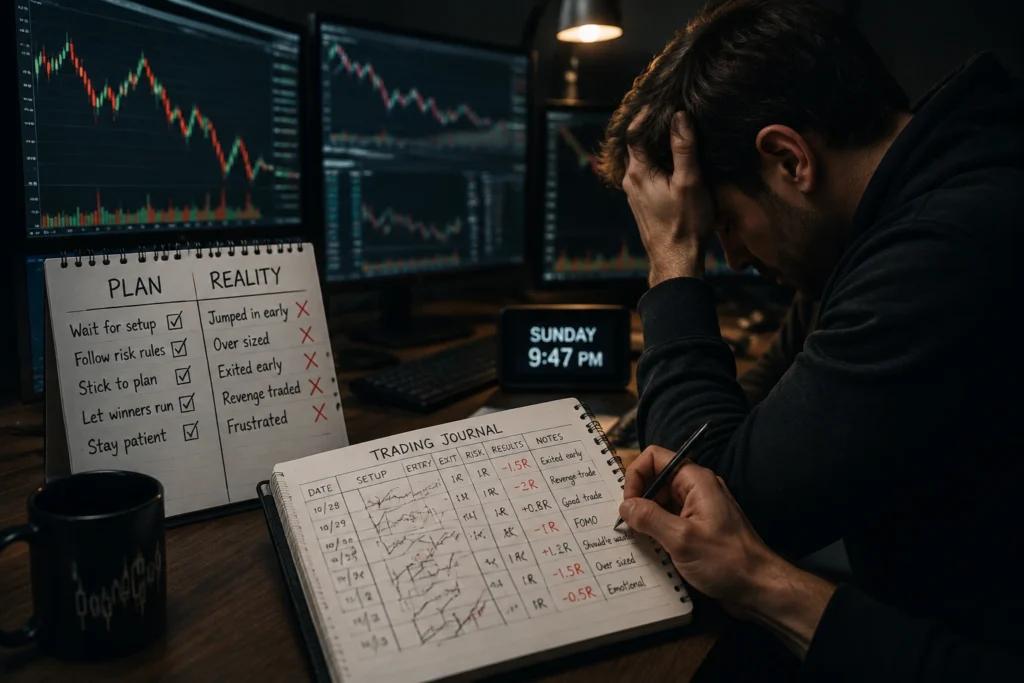
A trading journal that records emotional state alongside trade rationale reveals the measurable gap between an investor’s self-perceived skill and their actual track record. Standard trading journals track price and rationale. This template adds emotional state, the variable that standard journals omit and that Odean (1998) identified as a primary driver of miscalibrated forecasting.
| Field | What to Record | Why It Matters |
| Date & Asset | Ticker, entry price, position size | Creates an auditable trade history |
| Entry Rationale | 2–3 sentences on why you are entering | Forces explicit reasoning before execution |
| Confidence Level | Score of 1–10 | Tracks calibration between stated confidence and actual outcome |
| Emotional State | Excited, anxious, fearful, greedy | Identifies emotional states that precede losses, the variable standard journals omit |
| Exit Rules | Pre-planned stop-loss and take-profit levels | Removes in-trade emotional decision-making |
Monthly journal reviews surface behavioral patterns that feel invisible trade by trade. Track whether high-confidence trades outperform low-confidence ones. Identify which emotional states consistently precede losing positions.
3. Build Systematic Barriers
Rules-based constraints remove emotional decision-making from the investment process by making disciplined behavior the default, not the exception. Thaler & Sunstein (2008) demonstrated that choice architecture, designing the decision environment itself, produces more reliable behavioral change than relying on willpower alone.
Four constraints that produce measurable results:
• Cap individual position size at no more than 5% of total portfolio value.
• Enforce a 24–48 hour waiting period after any emotionally charged losing trade before placing the next one.
• Automate contributions and rebalancing to mechanically enforce buy-low, sell-high behavior.
• Allocate 70% of the portfolio to diversified index funds and limit active stock selection to 30%. This contains the financial damage that overconfident picks can produce.
4. Beware the Echo Chamber: Diversify Your Information Sources
Actively seeking disconfirming evidence is the direct behavioral antidote to the social echo chamber effect that amplifies overconfidence on digital platforms.Barber, Huang, Odean & Schwarz (2022), The Journal of Finance, found that attention-driven trading originating from social media platforms produced negative subsequent returns for retail investors; the measurable cost of mistaking community consensus for independent analysis.
FinTok, Reddit, and Discord investment communities function as social proof engines. FinTok and Reddit surface, confirming narratives repeatedly, amplifying the better-than-average effect through collective agreement rather than independent research. Investors who consume these sources exclusively mistake community consensus for personal insight.
Counter this by following analysts who hold a bearish view on your current positions and reading the formal short thesis for every stock you own. Apply the same structured selection criteria to information sources that you apply to portfolio positions.
5. The Expert’s Paradox: Stay Humble
An investor who accumulates more information and experience constructs increasingly coherent narratives, making it harder to identify what those narratives exclude.Fischhoff, Slovic & Lichtenstein (1977), Journal of Experimental Psychology: Human Perception and Performance, found that domain expertise does not produce better-calibrated confidence. Expert subjects showed miscalibration rates comparable to novices when estimating probabilities outside their direct experience.
Kruger & Dunning (1999), Journal of Personality and Social Psychology, identified the mechanism: metacognitive failure, the inability to recognize the precise limits of one’s own knowledge, connects expertise to overconfidence just as powerfully as incompetence does. Overconfidence bias produces the most serious damage among the most active traders. Among investors who trade infrequently, its impact is measurably smaller, though still present.
No position warrants 100% certainty because markets function as complex adaptive systems, not solvable puzzles. Adopting probabilistic thinking as a discipline is the structural response to this reality.
Conclusion: The Mindful Investor
Overconfidence bias is a natural feature of human cognition, not a character flaw, but left unchecked, this cognitive bias systematically erodes investment returns through overtrading, concentration, and poor timing. The three core mechanisms: illusion of control, better-than-average effect, and miscalibration, do not respond to awareness alone. They respond to structure.
The antidote is not willpower but architecture: pre-mortems, trading journals, position limits, and structured information selection create the conditions for calibrated decision-making. Investors who outperform over the long run are not the most confident; they are the most accurately calibrated.
Overconfidence bias remains behavioral finance’s most empirically documented threat to long-term returns. Systems separate calibrated investors from those who consistently underperform passive benchmarks.
Systematic process, not willpower, separates investors who preserve returns from those who erode them. At M1 Performance Group, Evan Marks works with high-performers to design the mental frameworks and processes that convert behavioral knowledge into lasting financial results.Explore the M1 Approach.
Frequently Asked Questions About Overconfidence Bias
What is the difference between overconfidence and optimism bias?
Optimism bias is a general tendency to overestimate the likelihood of positive outcomes. Overconfidence bias is specifically about overestimating one’s own skills, knowledge, and control. Optimism says “markets recover”; overconfidence says “I pick the winning stocks.” The two biases frequently co-occur. Overconfidence bias is the more financially damaging of the two because it directly inflates risk-taking behavior.
Is overconfidence bias the same as the Dunning-Kruger effect?
No, overconfidence bias and the Dunning-Kruger effect are related but not identical. The Dunning-Kruger effect is a specific subtype where low-ability individuals most severely overestimate their own competence due to limited metacognitive ability. Overconfidence bias is broader; it affects experienced investors and domain experts as well. (Kruger & Dunning, 1999)
What is the 70/30 rule in investing?
The 70/30 rule is a portfolio allocation framework that places 70% of capital in diversified, low-cost index funds and reserves 30% for active stock selection. In the context of de-biasing, the rule contains the financial damage that overconfident active picks can produce by ensuring the majority of capital follows a rules-based, emotion-free structure.
Can overconfidence ever be good for investors?
Yes, investment decisions under uncertainty require a calibrated degree of confidence. The problem arises when confidence becomes detached from evidence. Healthy confidence reflects a realistic assessment of one’s demonstrated edge. Overconfidence is miscalibrated confidence that systematically ignores contradicting risk signals and produces position sizes that exceed verified track record performance.