
I want you to look at your last 30 trades with fresh eyes.
On the trades that went your way, how long did you hold them?
On the trades that went against you, how long did you hold those?
Most traders already know the answer before they check. They just have not been willing to sit with what it actually means.
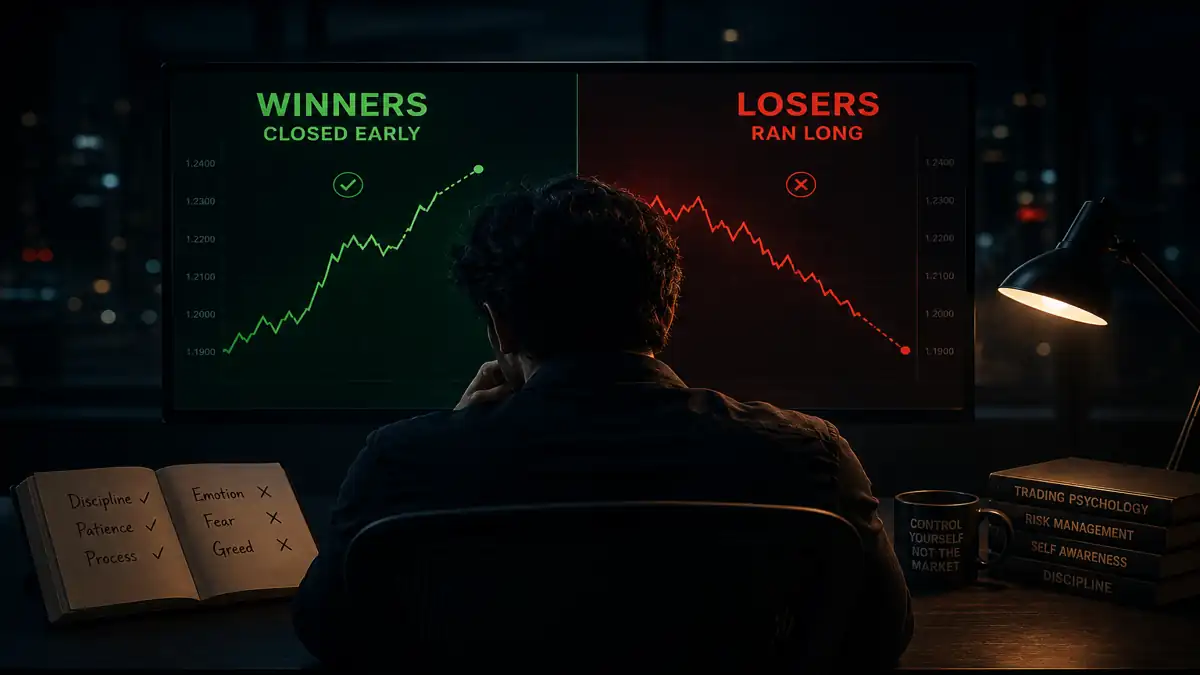
Your winners were closed early. Your losers ran long. And somewhere in your head, both of those decisions felt completely reasonable in the moment.
That asymmetry right there is costing you far more than any market condition ever has.
The real problem is not in the charts
Here is what I watched happen on institutional desks and in individual trading accounts for most of my career.
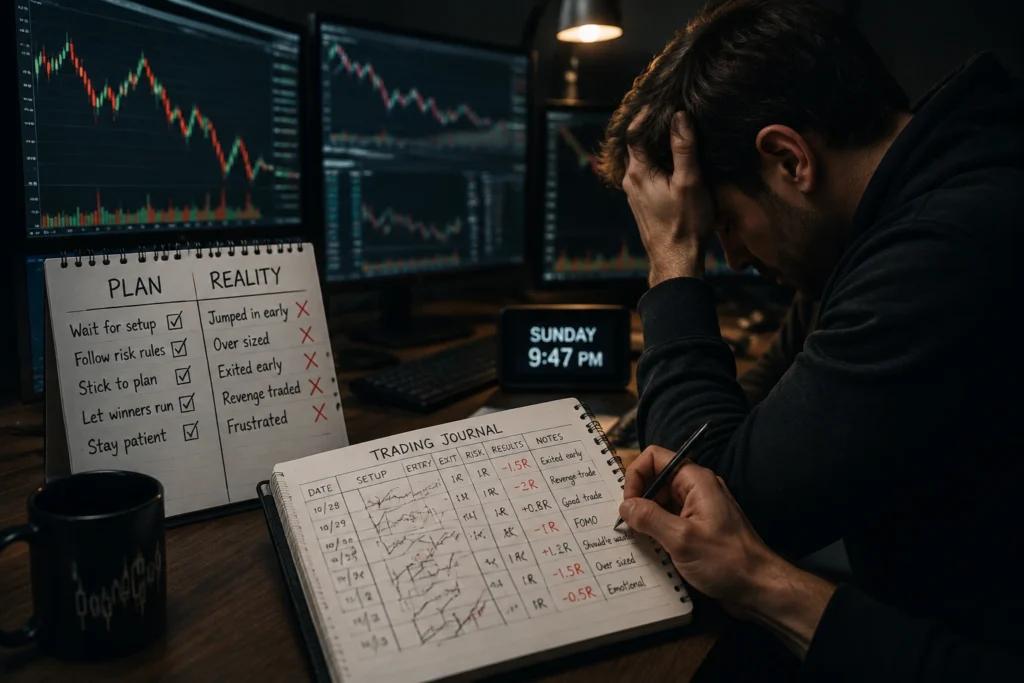
A trader builds a solid thesis. The setup is legitimate. The trade moves in their favor and they bank it at the first sign of resistance, well before the target, because something in their chest says take it now before it disappears.
The following week they take a trade that goes wrong. The trade moves against them. Their framework says exit. They hold it because closing the position would make the loss real, and something in their body refuses to let that happen.
One week later they are sitting on a loss three times larger than the win they banked the week before, wondering what the market is doing to them.
The market did not do anything to them.
What is actually driving this
Both patterns come from the same source.
The brain registers a potential loss as roughly twice as painful as an equivalent gain feels satisfying. That asymmetry is not a character flaw. It is a deeply wired neurological reality that every human being carries.
Cutting a winner early is the brain protecting itself from the pain of watching a gain disappear. Holding a loser too long is the brain protecting itself from the pain of making the loss permanent. Both decisions feel protective at the moment. Both are actively working against your edge.
| I talked about this extensively on the Desire To Trade Podcast, specifically around impulsivity, confidence, and what actually drives inconsistency in live trading. You can listen to that conversation here. |
“The detrimental impact of impulsivity on portfolios is real. The work is about shifting from reactive to responsive behavior in high-stakes environments.”
Evan Marks on the Making Billions Podcast with Ryan Miller
The math of this is brutal
Most traders focus entirely on their win rate.
They try to find better setups, better entries, better timing. They spend almost no time examining the asymmetry between how much they make when they win and how much they lose when they lose.
If your average winner is half the size of your average loser, you need to be right significantly more than 50% of the time just to break even.
A lot of experienced traders with genuine edges are operating with exactly that structural disadvantage and blaming the market for results that their own behavioral patterns are producing.
Rebuilding the strategy does not fix this. Switching instruments does not fix this.
The pattern travels with you because it lives in the person making the decisions, not in the system they are using.
This is identifiable and addressable
Behavioral interference of this kind is not permanent.
It follows identifiable patterns, activates under specific conditions, and responds to structured intervention.
The M1 research page documents this clearly. Three patterns show up in the majority of performance audits, and one of the most consistent is traders cutting winners at 1R while holding losers past 2R. That is not bad luck. That is a behavioral signature.
The starting point is making your own pattern visible with enough specificity that you can name exactly what you are most likely to do in the two or three situations where it shows up most.
That alone creates enough cognitive distance to interrupt it in real time.
The deeper work
Naming the pattern is the beginning. Conditioning the nervous system to stay regulated under the specific pressures that trigger these responses is the actual work.
That is what I do with traders and portfolio managers through the M1 process. The goal is durable improvement, not temporary adjustment.
If you are serious about understanding where this pattern is showing up in your own performance, start with a conversation.
The market is not your problem.
After 25 years inside professional capital environments, the gap between a trader’s edge and their actual results almost always comes down to behavioral interference. Fixing the strategy feels productive. Fixing the behavioral pattern is what actually changes the numbers.