

Mental imagery improves athletic performance by training the nervous system to execute skills, regulate pressure, and make decisions more efficiently, without adding physical load.
Athletes do not use imagery to “feel confident.”
They use imagery to prepare the brain for execution under real conditions.
When imagery is trained correctly, performance becomes more consistent, decisions become faster, and recovery after mistakes improves.
What mental imagery actually is (and what it is not)
Mental imagery is a deliberate rehearsal of performance actions using sensory detail, what the athlete sees, feels, and responds to, before or alongside physical practice.
Mental imagery is not:
- positive thinking
- motivation
- watching highlights in the mind
Mental imagery is controlled simulation.
It has a target skill, a real tempo, and a specific purpose.
Why mental imagery transfers to real performance
Mental imagery works because the brain processes imagined and executed actions through overlapping neural systems.
This creates three performance effects.
1. Skill execution becomes more stable
Imagery reinforces timing, sequencing, and coordination.
Athletes who rehearse movements mentally reduce execution variability when physical fatigue or pressure increases.
The benefit is consistency, not perfection.
2. Pressure becomes manageable instead of disruptive
Imagery allows athletes to experience pressure before competition.
When pressure cues, crowd noise, score situations, urgency, are rehearsed in advance, emotional reactions become predictable and easier to regulate.
This reduces hesitation and overcorrection.
3. Decisions happen faster
Imagery prepares the brain for “what happens next.”
Athletes who rehearse scenarios:
- recognize cues earlier
- commit faster
- recover quicker after mistakes
This matters most in open, reactive sports where hesitation costs performance.
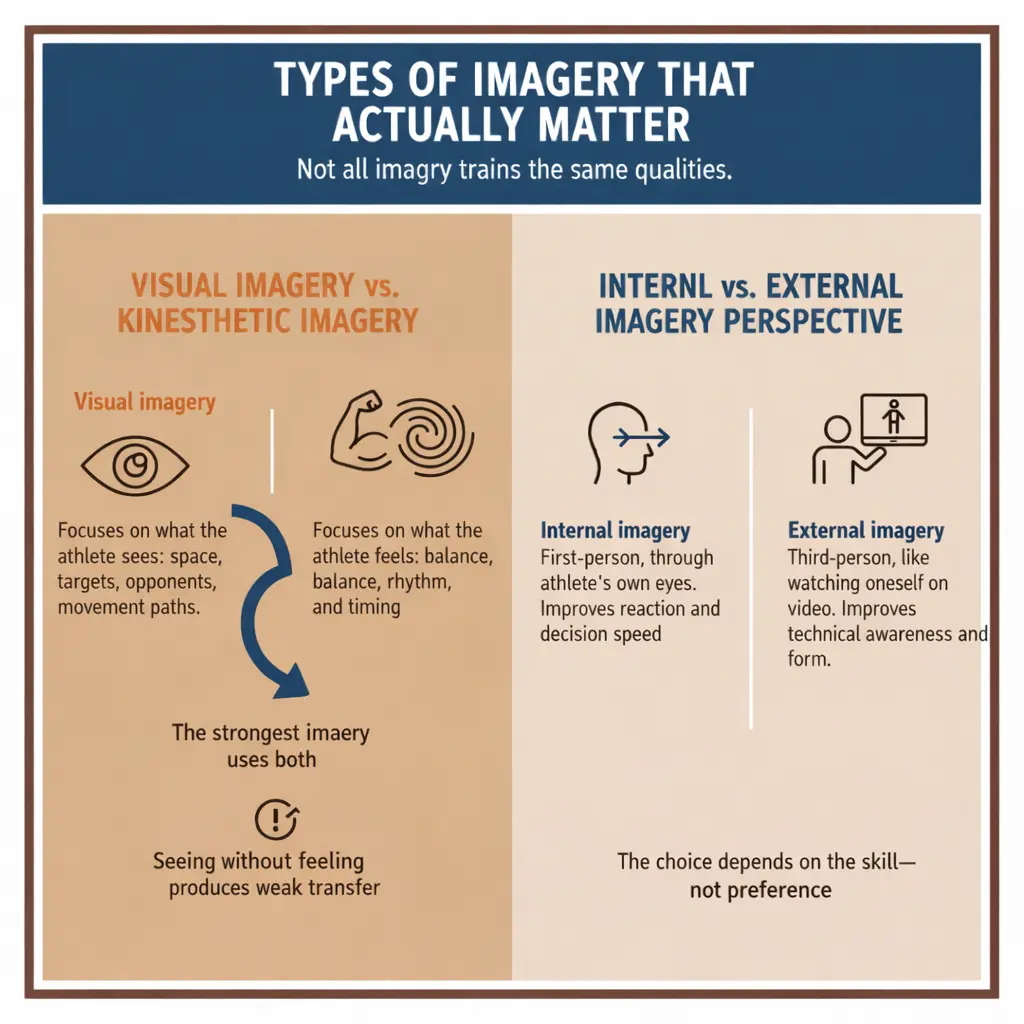
Types of imagery that actually matter
Not all imagery trains the same qualities.
Visual imagery vs. kinesthetic imagery
- Visual imagery focuses on what the athlete sees: space, targets, opponents, movement paths.
- Kinesthetic imagery focuses on what the athlete feels: balance, rhythm, tension, and timing.
The strongest imagery uses both.
Seeing without feeling produces weak transfer.
Internal vs. external imagery perspective
- Internal imagery is first-person, through the athlete’s own eyes.
- External imagery is third-person, like watching oneself on video.
Internal imagery improves reaction and decision speed.
External imagery improves technical awareness and form.
The choice depends on the skill, not preference.
How to practice imagery so it actually works
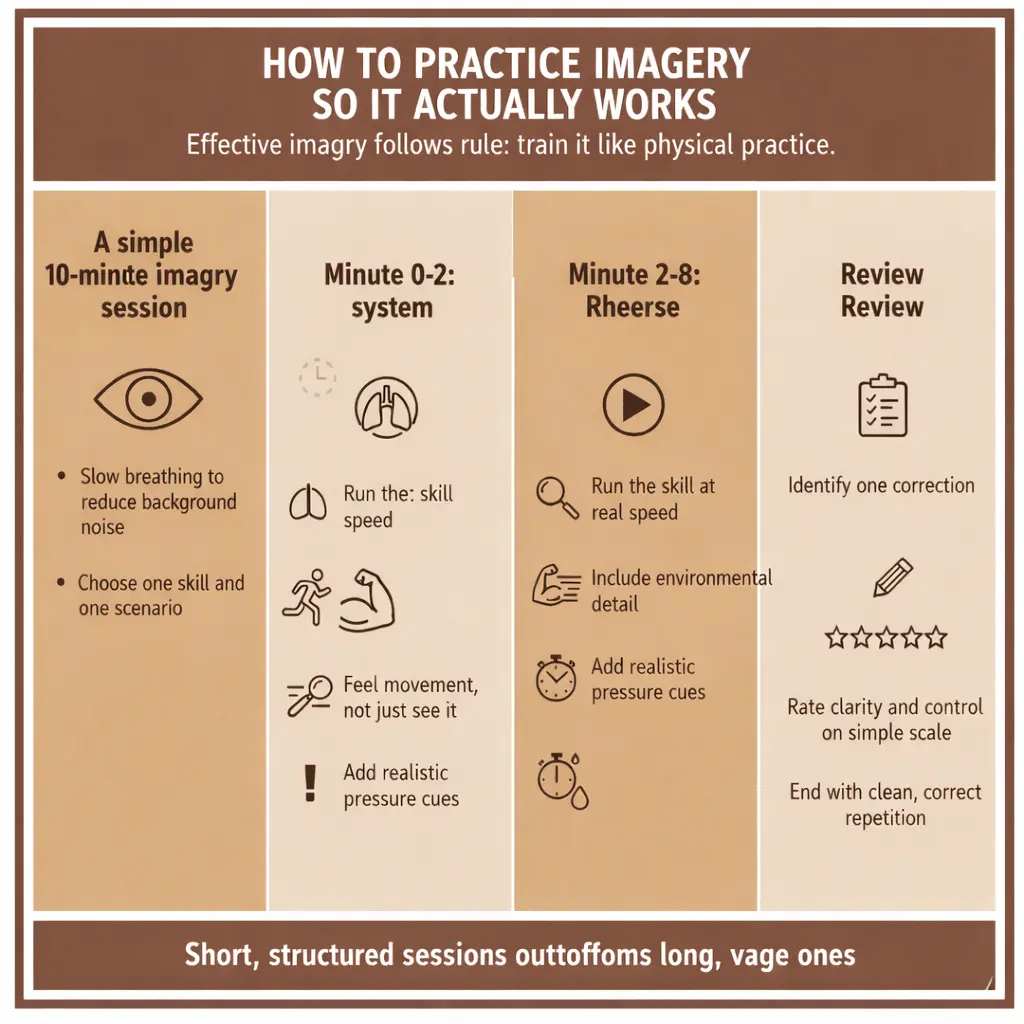
Effective imagery follows one rule: train it like physical practice.
A simple 10-minute imagery session
Minute 0-2: Set the system
- Slow breathing to reduce background noise
- Choose one skill and one scenario
Minute 2-8: Rehearse
- Run the skill at real speed
- Include environmental detail
- Feel the movement, not just see it
- Add realistic pressure cues
Minute 8-10: Review
- Identify one correction
- Rate clarity and control on a simple scale
- End with a clean, correct repetition
Short, structured sessions outperform long, vague ones.
How often imagery should be trained
Imagery works through repetition, not intensity.
A reliable structure is:
- short sessions
- multiple times per week
- sustained over months
Consistency matters more than duration.
Imagery placed before training primes execution.
Imagery placed after training consolidates learning.
Imagery placed before competition stabilizes emotions.
Common mistakes that reduce effectiveness
Most imagery fails for predictable reasons.
- Rehearsing too many skills at once
- Using slow motion for everything
- Ignoring emotional responses
- Watching performance instead of feeling it
- Practicing only “perfect” outcomes
Imagery must include errors, resets, and recovery, not just success.
How to know imagery is improving performance
Imagery improvement shows up in behavior before results.
Look for:
- faster commitment on first actions
- fewer hesitation errors
- quicker emotional recovery after mistakes
- tighter performance variance across repetitions
Confidence becomes stable, not fragile.
Final takeaway
Mental imagery is not a motivational tool.
It is a performance preparation system.
When imagery is specific, timed, and emotionally realistic, it reduces uncertainty and prepares athletes for execution under pressure.
Used correctly, imagery does not replace physical training.
It makes physical training transfer better.
Does mental imagery actually improve athletic performance?
Yes. Mental imagery improves athletic performance by training the nervous system to execute skills, regulate pressure, and respond faster during competition. When imagery is specific and realistic, it reinforces execution patterns that carry over to physical performance.
Is mental imagery the same as visualization?
Mental imagery is broader than visualization. Visualization focuses on what an athlete sees, while mental imagery also includes physical sensations, timing, emotions, and decision-making. Performance benefits are stronger when athletes include both visual and physical sensations.
How long does it take for mental imagery to show results?
Most athletes notice improvements within a few weeks when imagery is practiced consistently. Early changes usually appear as better focus, faster decisions, and quicker recovery after mistakes before measurable performance gains show up.
Should athletes imagine perfect performance only?
No. Effective imagery includes mistakes and recovery, not just perfect execution. Rehearsing how to reset after errors prepares athletes to stay composed and perform consistently under real competition pressure.
Can beginners use mental imagery, or is it only for elite athletes?
Mental imagery works for beginners and elite athletes alike. Beginners use imagery to learn movement patterns, while advanced athletes use it to refine timing, manage pressure, and sharpen decision-making in complex situations.