

Understanding Mental Performance Coaching: How It Works and the Science Behind It
Mental performance coaching operates at the intersection of cognitive neuroscience, behavioral psychology, and performance science. While the previous guide established what this discipline is, this article examines how it works the mechanisms, techniques, and evidence that transform psychological training into measurable performance outcomes.
The Psychology of Peak Performance
Peak performance emerges from specific neurocognitive conditions that coaching systematically cultivates. Understanding these foundations explains why mental skills training produces durable results.
Cognitive-Behavioral Principles
Mental performance coaching applies cognitive-behavioral framework principles adapted for performance contexts. This framework rests on 3 interconnected propositions:
- Thoughts influence emotions and behaviors: Interpretations of events, not events themselves, determine responses
- Performance patterns are learned: Psychological responses to pressure develop through experience and can be modified through structured practice
- Awareness precedes change: Recognizing automatic patterns creates opportunity for intentional selection
Application: A trader who interprets a losing position as “I’m failing” experiences anxiety and impulsive decisions. The same trader interpreting the loss as “market data requiring adjustment” maintains composure and executes strategy. Coaching restructures these cognitive appraisals.
Neuroplasticity: The Brain’s Change Mechanism
Neuroplasticity the brain’s capacity to reorganize structurally and functionally throughout life—provides the biological basis for mental performance coaching effectiveness.
Key neuroplasticity principles:
| Principle | Description | Coaching Application |
| Use-dependent plasticity | Neural pathways strengthen through activation | Repeated mental rehearsal builds durable skills |
| Synaptic pruning | Unused connections weaken and eliminate | Replacing maladaptive patterns with adaptive ones |
| Myelination | Repetition insulates neural pathways | Consistent practice increases processing speed and reliability |
| Experience-dependent plasticity | Structured experience shapes neural architecture | Deliberate practice protocols optimize brain adaptation |
Research evidence: Tang and colleagues (2015) demonstrated that 8 weeks of structured mental training produces measurable changes in prefrontal cortex activity and default mode network connectivity—changes that correlate with improved attention and emotional regulation.
Executive Function Architecture
Peak performance depends on 3 core executive functions:
- Working memory: Holding and manipulating information during decision-making
- Cognitive flexibility: Shifting between mental sets as conditions change
- Inhibitory control: Suppressing automatic responses in favor of intentional ones
Qualified instance: A hedge fund manager evaluating 12 potential positions simultaneously engages working memory to compare risk metrics, cognitive flexibility to adjust for new information, and inhibitory control to override fear-based selling during volatility.
Mental performance coaching targets these specific neural systems through techniques designed to strengthen each component.
Core Techniques Used by Mental Performance Coaches
Mental performance coaches employ 4 evidence-based technique families, each targeting specific psychological mechanisms.
1. Visualization and Imagery
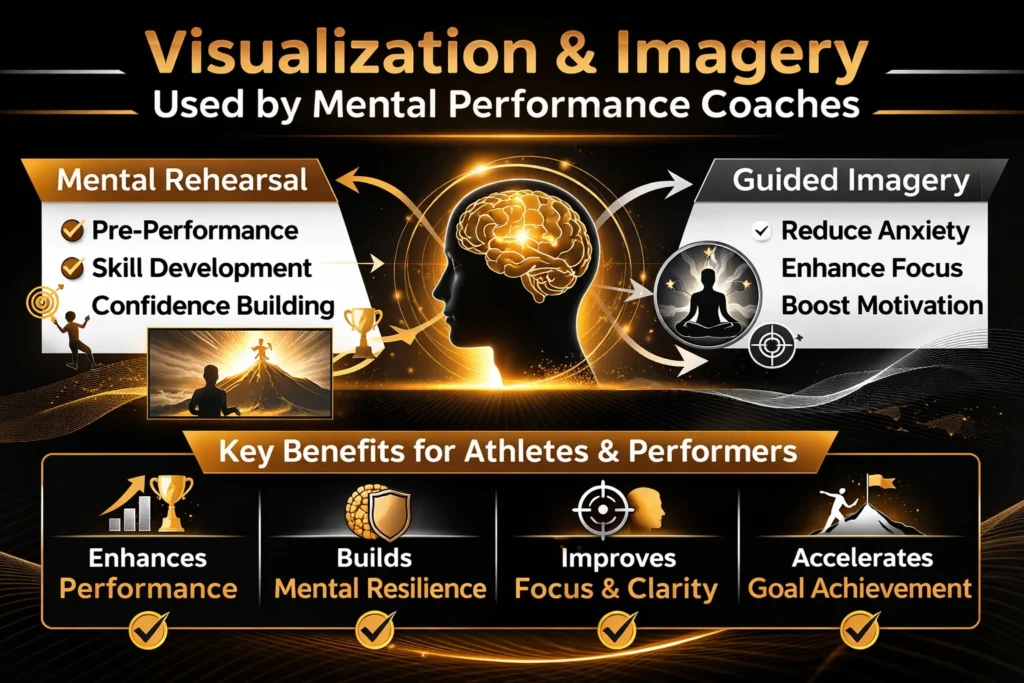
Definition: The systematic creation and rehearsal of sensory-rich mental experiences that simulate actual performance without physical execution.
How it works: Mental imagery activates the same neural networks as physical performance. When a trader visualizes executing a trade, the premotor cortex, supplementary motor area, and cerebellum activate similarly to actual execution—a phenomenon called functional equivalence.
Neurological mechanism: The mirror neuron system fires both during action observation and mental simulation, creating neural representations that strengthen through repetition.
Types of imagery:
| Type | Perspective | Application |
| Internal imagery | First-person, through own eyes | Rehearsing technical execution, feeling responses |
| External imagery | Third-person, observing self | Evaluating form, strategy visualization |
| Kinesthetic imagery | Sensation-focused | Rehearsing physical responses to pressure |
| Outcome imagery | Result-focused | Confidence building, goal reinforcement |
| Process imagery | Execution-focused | Technical precision, strategy adherence |
Research evidence: The PETTLEP model (Holmes & Collins, 2001) identifies 7 components maximizing imagery effectiveness—Physical, Environment, Task, Timing, Learning, Emotion, Perspective. Meta-analyses demonstrate that PETTLEP-based imagery improves performance by 12-15% across domains.
Application example: A trader visualizes the complete trading day—entering position, monitoring price action, adjusting to market movements, executing exits—with specific attention to emotional responses during volatility and strategic adherence during drawdowns.
2. Self-Talk and Cognitive Restructuring
Definition: The deliberate shaping of internal dialogue to support performance through specific, task-relevant verbalizations.
How it works: Self-talk influences performance through 4 mechanisms:
- Attentional focus: Directing attention to task-relevant cues
- Activation regulation: Increasing or decreasing arousal as needed
- Confidence enhancement: Reinforcing capability beliefs
- Automaticity development: Automating execution through verbal cues
Neurological mechanism: Self-talk engages the prefrontal cortex in regulating limbic system activity. Positive instructional self-talk reduces amygdala activation during stress, preserving cognitive resources for execution.
Types of self-talk:
- Instructional self-talk: Process-focused (“Watch the spread,” “Check volume,” “Execute strategy”)
- Motivational self-talk: Confidence-focused (“I’ve prepared for this,” “Trust the process,” “Stay disciplined”)
- Positive self-talk: Constructive framing (“This is data, not failure”)
- Negative self-talk: Destructive patterns to replace (“I always mess up,” “I can’t handle this”)
Research evidence: Hatzigeorgiadis and colleagues (2011) meta-analyzed 32 studies demonstrating that self-talk interventions improve performance by 0.48 effect size—equivalent to 10-15% performance improvement. Instructional self-talk shows strongest effects for fine motor tasks; motivational self-talk benefits gross motor and endurance tasks.
Cognitive restructuring process:
- Identify automatic negative thoughts during performance
- Examine evidence supporting and contradicting these thoughts
- Generate alternative, constructive interpretations
- Replace maladaptive patterns with intentional self-talk
- Reinforce through repetition until automatic
Application example: An executive who thinks “I’ll fail this presentation” identifies the thought, recognizes it as catastrophic thinking without evidence, and replaces it with “I’ve prepared thoroughly and will respond adaptively to questions.”
3. Goal Setting and Action Planning
Definition: The systematic establishment of performance targets combined with implementation protocols that translate intention into action.
How it works: Goal setting influences performance through 4 mechanisms (Locke & Latham, 2002):
- Directing attention: Focusing effort toward goal-relevant activities
- Mobilizing effort: Increasing intensity proportional to goal difficulty
- Enhancing persistence: Extending effort duration until goal achievement
- Promoting strategy development: Encouraging task-relevant knowledge and techniques
Neurological mechanism: Goal pursuit activates dopaminergic reward pathways in the ventral striatum and engages the anterior cingulate cortex in progress monitoring. Clear goals create neural reward anticipation that sustains motivation.
Goal types:
| Goal Type | Definition | Example |
| Outcome goals | Results compared to others | “Achieve top-quartile returns” |
| Performance goals | Results compared to personal standards | “Execute strategy with 95% adherence” |
| Process goals | Actions within performer’s control | “Complete pre-trade checklist before every position” |
Implementation intentions: Specific if-then plans that automate goal-directed behavior (Gollwitzer, 1999).
Structure: “If [situation], then I will [behavior]”
Examples:
- “If I experience three consecutive losses, then I will take a 15-minute break and review my process checklist”
- “If I feel anxiety before a presentation, then I will complete 4-7-8 breathing for 2 minutes”
Research evidence: Locke and Latham’s (2006) meta-analysis demonstrates that specific, challenging goals produce 16% performance improvement over vague or absent goals. Implementation intentions increase goal attainment by 2-3 times compared to goal setting alone.
4. Arousal Regulation and Mindfulness
Definition: Techniques that optimize physiological activation levels and attentional focus for specific performance demands.
How it works: Performance follows an inverted-U relationship with arousal—too little produces underperformance through insufficient activation; too much produces underperformance through anxiety and cognitive interference. Optimal arousal varies by task and individual.
Neurological mechanism: Arousal reflects autonomic nervous system balance between sympathetic (activation) and parasympathetic (recovery) branches. Regulation techniques strengthen vagal tone, improving the brain’s ability to modulate stress responses through the polyvagal system.
Key techniques:
| Technique | Mechanism | Application |
| Diaphragmatic breathing | Parasympathetic activation via vagus nerve | Rapid recovery between performance episodes |
| Progressive muscle relaxation | Reduced somatic tension signals safety | Pre-performance activation reduction |
| Heart rate variability biofeedback | Real-time autonomic feedback | Precision regulation training |
| Mindfulness practice | Default mode network regulation | Sustained attention, reduced rumination |
Heart rate variability (HRV) : The variation in time between heartbeats, indicating autonomic flexibility. Higher HRV correlates with better emotional regulation and cognitive performance under stress. Coaching increases HRV through structured breathing protocols.
Research evidence: Wells and colleagues (2012) demonstrated that 8 weeks of HRV biofeedback reduced performance anxiety in musicians by 37% and improved performance quality ratings by 23%.
Mindfulness mechanisms:
- Decentering: Observing thoughts without identification or judgment
- Attention regulation: Sustaining focus on present-moment experience
- Acceptance: Allowing uncomfortable experiences without resistance
Application example: A trader practices 10-minute morning mindfulness, noticing thoughts about previous day’s losses without engaging them, returning attention to breath repeatedly—training the attention muscle for market hours.
How These Techniques Apply to High-Stakes Professions
Financial Traders
Performance demands: 50-500 daily decisions under uncertainty; emotional regulation during gains and losses; sustained attention for 8-12 hours; rapid recovery from setbacks
Technique application:
| Technique | Specific Application |
| Visualization | Pre-market rehearsal of executing strategy during specific scenarios (gap openings, volatility spikes, news events) |
| Self-talk | “Execute the strategy” replacing “Don’t lose money” during drawdowns; “Process over outcome” after losses |
| Goal setting | Process goals focused on strategy adherence rather than profit targets; implementation intentions for emotional triggers |
| Arousal regulation | 2-minute breathing protocols between trades; HRV training for sustained regulation |
Qualified instance: A proprietary trader executes 200+ daily transactions. After 3 consecutive losses, sympathetic activation increases 40%, threatening strategy adherence. A pre-programmed implementation intention—”If 3 losses occur, complete 2 minutes of box breathing before next entry”—restores baseline within 4 minutes.
Corporate Executives
Performance demands: Strategic decisions under uncertainty; team leadership during crises; board presentations; investor relations
Technique application:
| Technique | Specific Application |
| Visualization | Rehearsing board presentations with multi-sensory detail; anticipating difficult questions and response rehearsal |
| Self-talk | Replacing “I must be perfect” with “I am prepared and adaptable”; “This is challenge, not threat” reframing |
| Goal setting | Distinguishing outcome goals (fundraising targets) from process goals (communication quality, relationship building) |
| Arousal regulation | Pre-presentation breathing protocols; between-meeting recovery practices |
Research evidence: Executive coaching incorporating these techniques produces 29% improvement in decision-making quality under pressure (Jones et al., 2016).
Hedge Fund Managers
Performance demands: Multi-million dollar portfolio oversight; investor confidence maintenance; performance pressure compounding; risk assessment under uncertainty
Technique application:
| Technique | Specific Application |
| Visualization | Mental rehearsal of navigating drawdown periods while maintaining strategic discipline |
| Cognitive restructuring | Reframing drawdowns as inevitable market cycles rather than personal failure |
| Self-talk | “Risk management is working” during volatility; “Process precedes outcomes” reinforcing discipline |
| Arousal regulation | Maintaining composed presence during investor communications regardless of performance |
Scientific Backing: What Research Says
Meta-Analytic Evidence
| Domain | Studies | Effect Size | Finding |
| Mental skills training | 45 studies | 0.54 (moderate) | Structured psychological skills programs improve performance across domains |
| Visualization | 63 studies | 0.48 (moderate) | Mental imagery produces performance improvements 50-70% of physical practice |
| Self-talk | 32 studies | 0.48 (moderate) | Instructional self-talk shows strongest effects for precision tasks |
| Goal setting | 78 studies | 0.56 (moderate) | Specific, challenging goals outperform “do your best” instructions |
| Arousal regulation | 28 studies | 0.41 (small-moderate) | Biofeedback-assisted regulation shows strongest effects |
Neuroscience Evidence
Functional MRI studies:
- Mental imagery activates 70% of the same neural networks as physical execution (Jeannerod, 1994)
- Self-talk reduces amygdala activation during stress exposure (Paret et al., 2011)
- Mindfulness training increases prefrontal cortex thickness and reduces default mode network activity (Lazar et al., 2005; Tang et al., 2015)
- Goal pursuit engages dopaminergic reward pathways, sustaining motivation (Locke & Latham, 2002)
Longitudinal Outcomes
3-year follow-up study (Brown et al., 2018) :
- Professionals completing 6-month mental performance coaching programs maintained 78% of gains at 3-year follow-up
- Those continuing periodic booster sessions maintained 92% of gains
- Performance improvements translated to measurable career outcomes: 23% faster promotion rates, 31% higher performance ratings
Why Mental Performance Coaching Is Different for Business vs. Sports
While techniques overlap, business applications require distinct adaptations:
Temporal Structure Differences
| Dimension | Sports Context | Business Context |
| Performance schedule | Predictable competitions, defined seasons | Continuous, unpredictable demands |
| Recovery windows | Between plays, timeouts, halftime | Between meetings, decisions, often compressed |
| Performance duration | Defined game/event length | Extended hours, days, weeks without breaks |
| Stakes | Game outcome, rankings | Capital allocation, career trajectory, organizational impact |
Technique Adaptations
Visualization in business: Sports imagery often focuses on specific competitive moments. Business imagery must accommodate continuous, unpredictable demands—rehearsing decision-making frameworks rather than specific scenarios.
Self-talk in business: Sports self-talk often involves brief cues. Business requires more complex cognitive restructuring addressing strategic thinking, leadership presence, and long-term perspective.
Goal setting in business: Sports goals often cycle by season. Business requires integrating daily process goals with quarterly, annual, and multi-year outcomes.
Professional Identity Integration
Business professionals often resist “sports psychology” framing despite needing identical skills. Mental performance coaching for business contexts emphasizes:
- Decision science and cognitive optimization language
- Executive function rather than “mental game”
- Professional development rather than “performance enhancement”
- Return on investment metrics aligned with business outcomes
Case Study: Systematic Implementation
Background: Senior portfolio manager at multi-strategy hedge fund. Managed $450M book with 8-year track record. Sought coaching after 18-month period of underperformance relative to benchmarks.
Initial assessment findings:
- Strong technical skills, established strategy
- Decision-making quality deteriorated during drawdown periods
- Extended rumination after losses affecting subsequent decisions
- Sleep disruption during volatile periods
- Strategy adherence declined from 94% to 71% during stress
12-session intervention:
| Phase | Sessions | Focus | Techniques |
| Assessment | 1-2 | Baseline measurement, goal setting | Performance history review, psychological skills inventory |
| Skill acquisition | 3-6 | Core technique introduction | Visualization protocol, self-talk restructuring, implementation intentions |
| Applied practice | 7-10 | In-vivo application | Real-time technique use, journaling, feedback refinement |
| Integration | 11-12 | Maintenance planning | Booster schedule, long-term protocols |
Specific protocols:
- Morning visualization (8 minutes): Rehearsing strategy execution across 3 scenarios—normal volatility, high volatility, news events
- Self-talk protocol: “Execute strategy” (instructional) replacing “Don’t lose” during uncertainty; “Process over outcome” after losses
- Implementation intentions: “If I experience 2 consecutive losing trades, I will complete 3-minute breathing before next entry”
- Evening journaling: 5-minute reflection on strategy adherence, emotional patterns, technique effectiveness
Measurable outcomes:
| Metric | Pre-Coaching | 6 Months | Change |
| Strategy adherence | 71% (during stress) | 89% | +18% |
| Recovery time after loss | 23 minutes | 8 minutes | -65% |
| Sleep quality (PSQI) | 9 (poor) | 4 (good) | 56% improvement |
| Sharpe ratio | 1.2 | 1.8 | +50% |
| Drawdown depth | -8.3% | -4.1% | 51% reduction |
Client perspective: “I entered skeptical—I’ve been doing this 15 years. The difference isn’t in what I know about markets. It’s in what I can access psychologically when pressure peaks. The techniques automated responses I used to have to think through.”
Conclusion: From Understanding to Application
Mental performance coaching transforms psychological science into practical capability. The techniques examined here—visualization, self-talk restructuring, goal setting with implementation intentions, arousal regulation—operate through established neurological mechanisms: neuroplasticity, executive function strengthening, autonomic regulation, and cognitive reappraisal.
Research confirms what high performers across domains discover: psychological skills are trainable. The same systematic practice that develops technical expertise develops mental capabilities when structured appropriately.
For financial services professionals, this science translates directly to performance metrics: strategy adherence during volatility, rapid recovery from losses, sustained attention through extended sessions, confident decision-making under uncertainty.