

Decision Making Under Pressure in Trading
Two traders look at the exact same setup. Same chart, same news, same risk parameters. One waits a beat, takes the trade cleanly, and walks away regardless of outcome. The other freezes for half a second too long, then forces an entry that has nothing to do with the original plan. The market did not […]
How Traders Recover After Losses

A bad loss does not end when the position closes. That is the part nobody warns you about when you start trading. You can exit the trade, close the platform, walk away from the desk, and still be carrying the loss three hours later in ways you cannot see directly. It shows up in your […]
Mental Performance Coaching for Traders

Most trading coaches were never in the seat. They studied performance psychology, got certified, and built a coaching practice around principles that sound right on paper. What they have not done is sit with real capital on the line, watch a position move against them at size, and feel the specific kind of pressure that […]
What Is Trading Psychology?

I am going to give you a different answer than the one you have probably already read somewhere else today. Most articles on this topic say trading psychology means managing fear and greed. That definition is not wrong. It is just thin, and thin definitions do not help anyone actually fix what is going on […]
The Meeting That Wrecked Your Afternoon Session

Most traders blame the market when an afternoon session goes wrong. After 25 years of managing institutional capital, I’ve learned that’s rarely the real reason. It usually starts before you even touch the charts. A tough conversation with a senior partner, a risk review that leaves a bit of tension, or a small comment that […]
Why Smart Traders Still Underperform When Their Analysis Is Right

Smart traders can still underperform when their analysis is right because analytical skill and execution consistency are different capabilities. A sound thesis does not automatically prevent fear, loss aversion, urgency, open P&L, or recent losses from changing an entry, exit, position size, or risk decision once capital is exposed. Before treating the problem as psychological, […]
How to Help Someone Who Is Mentally Exhausted

When someone is mentally exhausted, the change is often easier to notice than to explain. They may become quieter, more irritable, forgetful, or withdrawn, and ordinary decisions can start to feel like too much. Helping begins by lowering pressure rather than trying to fix everything. Approach them gently, make it clear that you have noticed, […]
What is Anchoring Bias in Behavioral Finance?

An investor buys a stock at $80. It falls to $52 after the business outlook weakens, yet $80 still feels like the price that matters. That is anchoring bias in behavioral finance: the tendency to give an initial number or reference point too much influence, even after new evidence should change the decision. The problem […]
What Actually Happens to Your Brain During a Drawdown

Three losses in, a trader stares at a setup that looks identical to the one that worked last Tuesday. The entry criteria are met. The risk is sized right. And still, the finger hovers over the mouse a beat too long, or slams down a beat too early. That hesitation, or that overcorrection, rarely gets […]
You Are Not Losing to the Market. You Are Losing to Yourself.
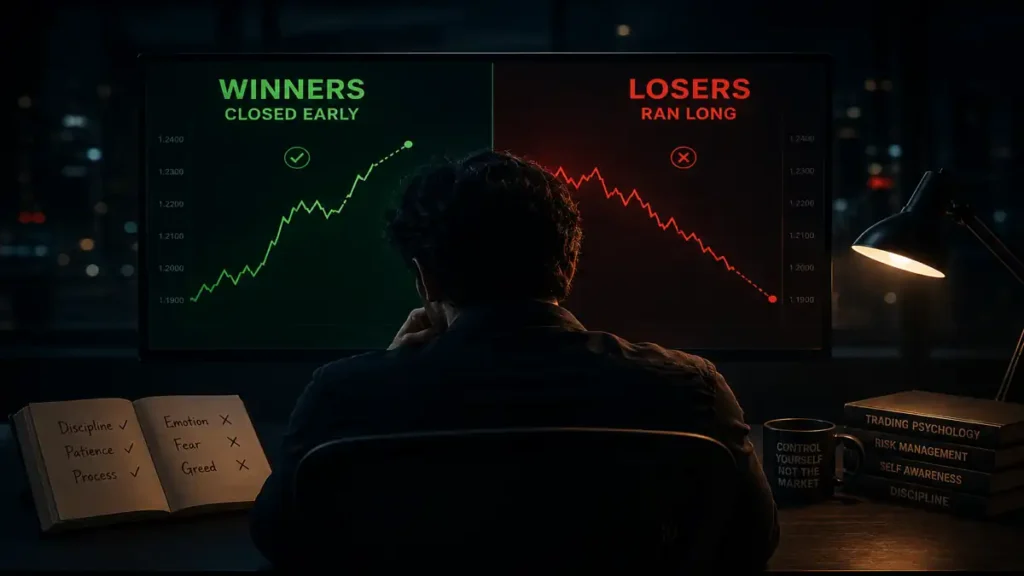
I want you to look at your last 30 trades with fresh eyes. On the trades that went your way, how long did you hold them? On the trades that went against you, how long did you hold those? Most traders already know the answer before they check. They just have not been willing to […]